




Candour Legal GCC — Legal Services for Global Capability Centres in India
Candour Legal GCC — Your Legal Partner for Global Capability Centres in India
Setting up or running a Global Capability Centre in India means handling FEMA, FDI policy, the DPDP Act, transfer pricing, the new labour codes, and cross-border IP ownership at the same time. Candour Legal GCC gives you one legal partner across all of it, from incorporation through steady-state operations and beyond.
1,800+
GCCs operating in India
200+
include a Legal & Compliance function
40–50%
cost savings vs Western legal talent
220,000+
corporate lawyers in India
Two kinds of GCC. Two kinds of legal need.
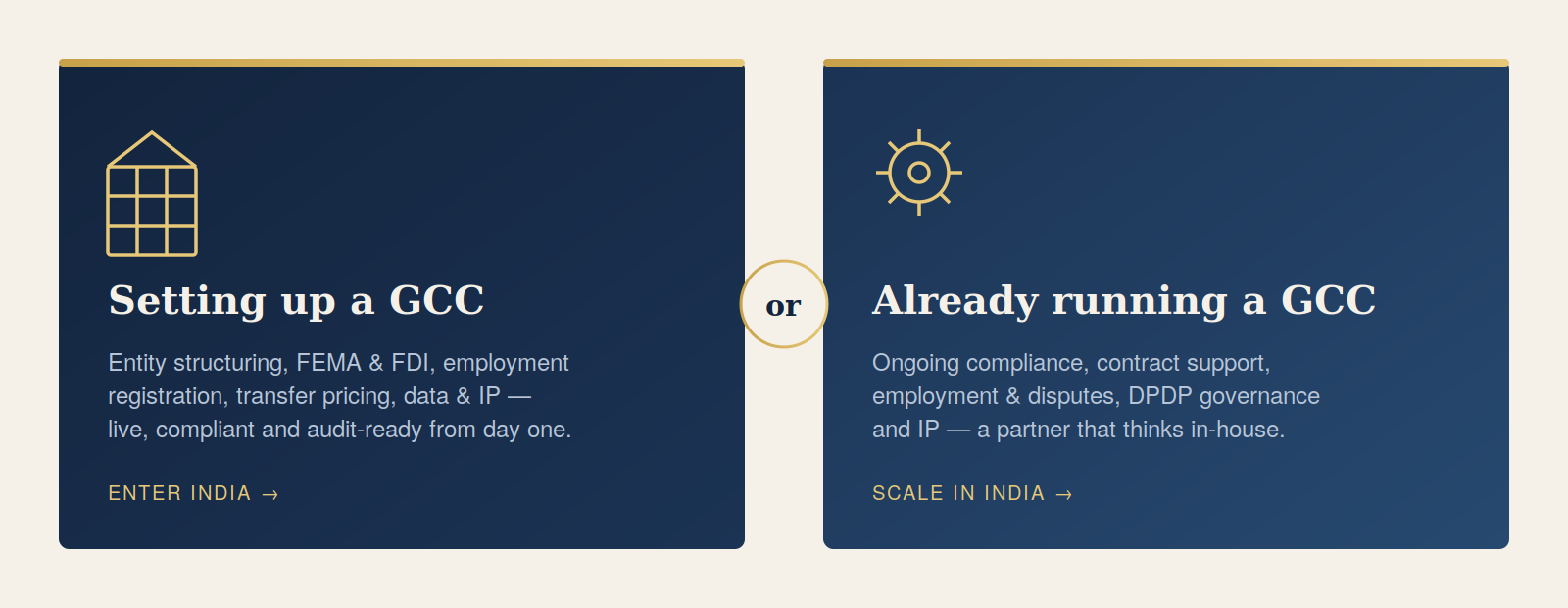
Setting up a GCC in India
You are a multinational entering India. You need the right entity structure, FEMA and FDI compliance, employment registrations, a tax-efficient operating model, and data and IP protection in place before you launch. We get you live, compliant, and audit-ready.
Already running a GCC
Your GCC is operational and your legal team is stretched. You need ongoing compliance management, high-volume contract support, employment and disputes advisory, DPDP governance, and IP protection — from a team that works the way your in-house counsel does.
GCC Setup Services
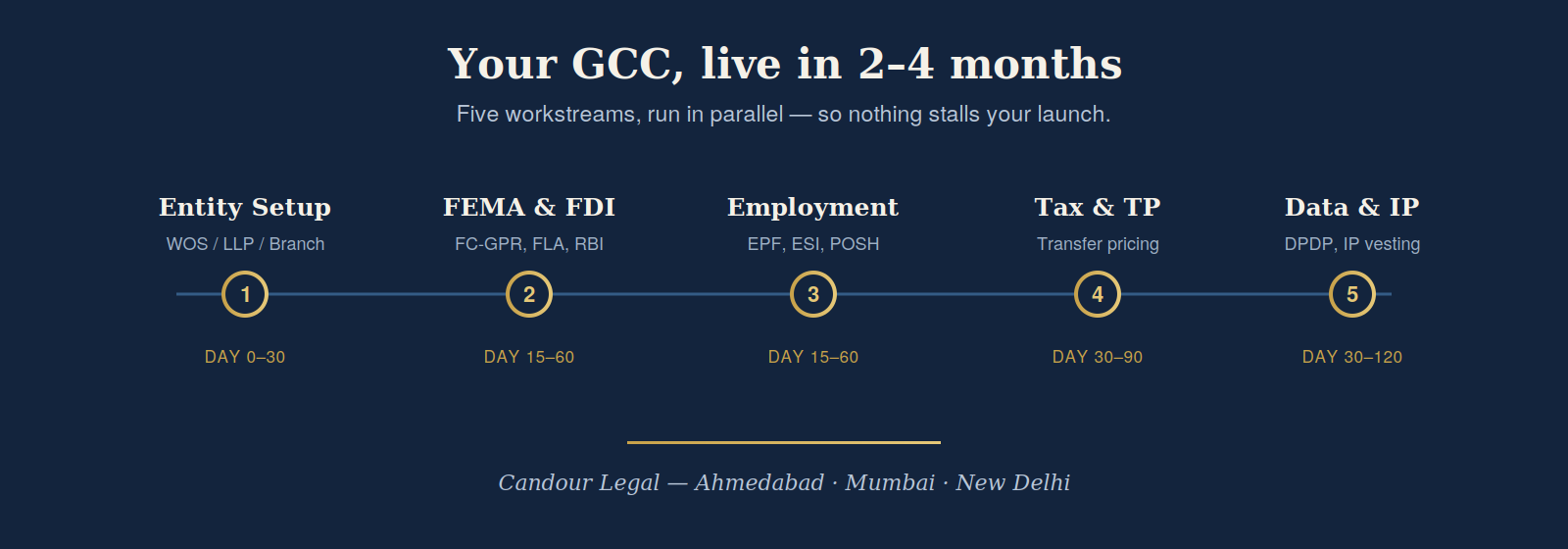
Legal and compliance setup for a GCC usually takes two to four months. We run the workstreams in parallel so nothing holds up your launch.
Entity Structuring & Incorporation
Choosing the right legal form — Wholly Owned Subsidiary, LLP, or Branch Office — and completing incorporation under the Companies Act. We handle MCA registration, Director Identification Numbers, Digital Signature Certificates, PAN, TAN, GST registration, resident director requirements, and governance setup.
FEMA & FDI Compliance
Foreign investment into a GCC must comply with FEMA, FDI policy, and RBI guidelines. We advise on the automatic versus approval route, file FC-GPR and FLA returns, manage share allotment and capital repatriation, and flag the prior-approval requirement that applies to investors from land-bordering countries.
Employment Contracts & HR Policies
Offer letters, employment agreements with clear IP assignment clauses, ESOP and equity plans, and restrictive covenants. We complete registration under the Shops and Establishments Act and set up EPF, ESI, POSH (including the Internal Complaints Committee), and gratuity frameworks.
Transfer Pricing & Tax Structuring
Intercompany Master Service Agreements and Statements of Work structured at arm’s length, with transfer pricing documentation — master file and local file — built to withstand audit. We advise on GST treatment of cross-border services and assess SEZ benefits where they fit your operating model.
Data Protection & IP Ownership
A DPDP Act 2023 compliance framework built around the notified DPDP Rules 2025 — consent architecture, cross-border data transfer terms, and processor controls in vendor contracts. We secure IP ownership through employment and vendor agreements, advise on patent and copyright filings for India-developed IP, and put strong NDAs in place.
Master Service Agreements & SLAs
Intercompany MSAs between parent and GCC, SLAs with defined scope, deliverables, and performance metrics, plus vendor and facility agreements. Every contract is reviewed against Indian contract, tax, and data protection law to prevent disputes before they start.
Ongoing Legal Support for Operating GCCs
FEMA reporting obligations like FC-GPR and FLA filings, statutory audits, labour compliance, and DPDP governance are standing requirements that continue for as long as your GCC operates. We manage them as your extended legal team.
Regulatory Compliance Calendar
MCA annual filings, GST returns, TDS, FEMA FLA and FC-GPR filings, ROC compliance, and labour law audits — tracked, managed, and filed on time, with a single dashboard of what is due and what is done.
Contract Support Desk
High-volume contract review, NDA management, vendor agreements, and SLA amendments, supported by a contract playbook we build and maintain for your legal team — so routine contracting moves at speed.
Employment & Labour Law
Employee disputes, disciplinary proceedings, POSH investigations, compliance with the new labour codes, remote work policies, and exit and severance management — handled with an eye to workforce stability and litigation risk.
DPDP & Data Governance
Ongoing Digital Personal Data Protection Act compliance — privacy notices, consent management, data processing agreements with vendors, breach response protocols, and the audit-ready documentation regulators expect.
Intellectual Property Protection
Patent and trademark filings for IP developed in India, IP audits of employment and vendor contracts to confirm ownership vests with the parent, technology and IP licensing arrangements, and copyright registrations.
Disputes & Risk Advisory
Employment and vendor contract disputes, arbitration support, responses to regulatory investigations, and statutory notices — managed early, before they escalate into cost and reputational exposure.
Frequently Asked Questions
What is the best legal structure for a GCC in India?
The most common structure is a Private Limited Company (Wholly Owned Subsidiary), which offers limited liability and operational flexibility. An LLP suits smaller or specialised operations but has limits on equity funding and scalability. A Branch Office is generally restricted to specific activities. The right choice depends on your funding plans, scale, and whether SEZ or IFSC benefits apply.
Is FEMA compliance mandatory for a GCC?
Yes. Any GCC with foreign ownership must comply with FEMA and India’s FDI policy. While IT and IT-enabled services allow 100% foreign investment through the automatic route, FEMA reporting obligations — including FC-GPR on investment and annual FLA filings — apply from the outset and continue for the life of the entity.
What does the DPDP Act mean for my GCC?
GCCs handle sensitive enterprise and personal data, so the Digital Personal Data Protection Act 2023 and the notified DPDP Rules 2025 apply directly. You need a consent framework, privacy notices, data processing agreements with vendors, cross-border transfer controls, and breach response protocols — built as an audit-ready operating system, not assembled after an incident.
Do I need a resident director?
Yes. Under the Companies Act, at least one director of an Indian company must be a resident of India. This is a standing requirement and a common early stumbling block for foreign companies setting up a GCC.
How long does it take to set up a GCC in India?
Legal and compliance setup typically takes two to four months depending on entity type and sector. Company formation usually runs 30 to 90 days, payroll and employment setup 15 to 60 days, and data protection framework setup 30 to 120 days. Running these workstreams in parallel is what keeps the timeline tight.
How is employee and vendor IP protected in a GCC?
Through clear IP ownership and assignment clauses in every employment and vendor contract, ensuring all work product vests in the parent enterprise. For GCCs in R&D, product, or analytics, this is backed by patent and copyright filings for India-created IP and strong confidentiality agreements protecting source code and business processes.
What employment compliances apply to a GCC?
Registration under the Shops and Establishments Act, plus compliance with EPF, ESI, POSH (including a constituted Internal Complaints Committee), and gratuity laws. Payroll records and statutory filings must be maintained, and the four new labour codes are reshaping these obligations as they come into force.
Can Candour Legal support both setup and ongoing operations?
Yes. Candour Legal GCC is built as a single partner across the full lifecycle — from entity structuring and FEMA-compliant incorporation through to ongoing compliance management, contract support, employment advisory, DPDP governance, IP protection, and disputes. You keep one team that already knows your business.
Talk to Candour Legal GCC
Whether you are evaluating India as a GCC location or you already run one and need a sharper legal partner, we are ready to help.
Candour Legal — Ahmedabad, Mumbai, New Delhi.
BEFORE YOU GO
Get a free 15-minute case assessment
Tell us what’s going on and a Candour Legal advocate will call you back — no charge, no obligation.
Schedule my free assessment Call nowSpeak to a senior advocate about your matter.
Tell us what's going on. We review every enquiry personally and reply within 24 working hours.
Schedule a Consultation
Takes under a minute. We'll come back to you within 24 working hours.
Request received.
Thank you — a Candour Legal advocate will contact you within 24 working hours.
Urgent? Call us right away.