Candour Legal – Best Lawyers in Ahmedabad | Law firm in Ahmedabad





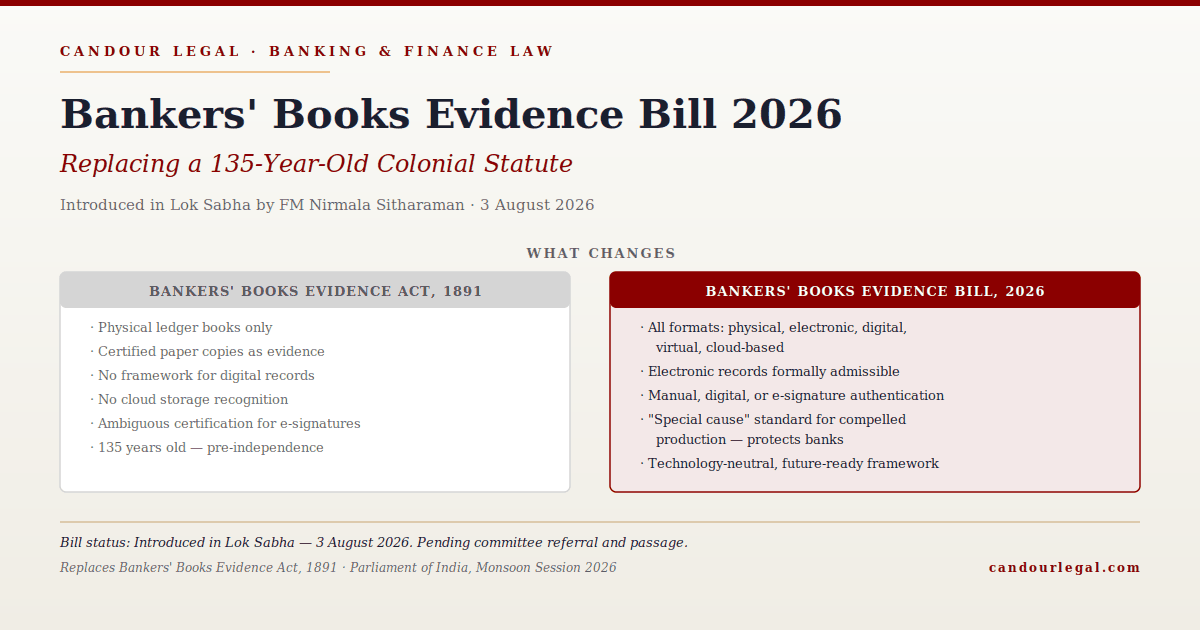
Finance Minister Nirmala Sitharaman introduced the Bankers’ Books Evidence Bill, 2026 in the Lok Sabha on 3 August 2026 — the first day of the Monsoon Session’s second phase — to replace the Bankers’ Books Evidence Act, 1891. The Bill was passed by the Lok Sabha on 5 August 2026 and the Rajya Sabha on 10 August 2026, received Presidential assent on 13 August 2026 as the Bankers’ Books Evidence Act, 2026 (Act No. 15 of 2026), and has been brought into force from 1 October 2026 (S.O. 5041(E), 10 September 2026); the 1891 Act stands repealed from that date. The 135-year-old statute was drafted at a time when every banking record was a physical ledger entry; it has been amended incrementally over the decades but was never purpose-built for cloud-stored, digitally signed, or distributed transaction data. The 2026 Act addresses that structural gap by expanding the definition of “bankers’ books” to cover all record formats — physical, electronic, digital, virtual, and cloud-based — and by formally recognising electronic banking records as admissible evidence in legal proceedings, subject to standardised certification. For litigation counsel, banking practitioners, and forensic auditors, the Act reconfigures the evidential infrastructure for every future banking dispute.
Key Takeaways
- The Bankers’ Books Evidence Bill, 2026 was introduced in Lok Sabha on 3 August 2026 by Finance Minister Nirmala Sitharaman; it was passed by the Lok Sabha on 5 August 2026 and the Rajya Sabha on 10 August 2026, received Presidential assent on 13 August 2026 (Act No. 15 of 2026) and was brought into force from 1 October 2026 (S.O. 5041(E), 10 September 2026).
- The Act replaces the Bankers’ Books Evidence Act, 1891, which was in force for over 135 years and stands repealed from 1 October 2026.
- “Bankers’ books” are redefined to include all record formats: physical, electronic, digital, virtual, cloud-based, and any other form maintained by banks.
- Electronic banking records are formally recognised as admissible evidence — a technology-neutral, future-ready framework.
- Certification is standardised: courts can receive bank records in physical or electronic form, authenticated through manual, digital, or electronic signature.
- A “special cause” standard is introduced for compelling a bank officer to produce records or testify in proceedings where the bank is not a party — raises the bar for third-party litigation demands on banks.
- The existing 1891 Act was enacted when banking records were exclusively maintained in physical form; its evidentiary framework has been strained by the shift to digital, cloud, and CBS-based banking.
What the 1891 Act Did and Where It Broke Down
The Bankers’ Books Evidence Act, 1891 was designed to solve a specific 19th-century problem: how to admit bank records as evidence without requiring banks to produce original ledger books — which was disruptive to a bank’s functioning — in every court proceeding where a transaction was in dispute. The Act allowed certified copies of entries in bankers’ books to be received as evidence of the matters, transactions, and accounts recorded, without requiring the original books or a live bank officer. That framework functioned reasonably well for a century of paper-based banking.
It began to strain when digital banking records became the norm. The Information Technology Act, 2000 addressed electronic records generally in Section 65B of the Indian Evidence Act, 1872 (now the Bharatiya Sakshya Adhiniyam, 2023) — and amended the Bankers’ Books Evidence Act so that bankers’ books included printouts of data stored on electromagnetic devices (Section 2(3)), with certification conditions for such printouts prescribed in Section 2A. The result was interpretive uncertainty in banking litigation: were digital transaction logs “bankers’ books”? Were cloud-stored records covered? What certification was required for a digitally signed statement of accounts produced in a debt recovery proceeding? The 2026 Bill resolves these questions legislatively.
| Feature | Bankers’ Books Evidence Act, 1891 | Bankers’ Books Evidence Act, 2026 |
|---|---|---|
| Definition of bankers’ books | Ledgers and other books; since the IT Act, 2000 amendments, also printouts of data stored on electromagnetic devices (Section 2(3)) | All formats — physical, electronic, digital, virtual, cloud-based |
| Electronic records | Printouts of electronically stored data covered by Section 2(3), with certification conditions prescribed in Section 2A | Formally recognised as admissible evidence |
| Certification / authentication | Copies certified by the principal accountant or manager of the bank (Section 2(8)) | Manual, digital, or electronic signature |
| Compelled production of records | Court order — threshold unclear | “Special cause” standard — defined threshold, bank-protective |
| Age | 135 years — pre-independence colonial statute | Technology-neutral, future-ready framework |
The Three Core Changes
First: The definitional expansion. The Bill expands “bankers’ books” to cover any record maintained by a bank — whether physical, electronic, digital, virtual, cloud-based, or in any other form. This is a technology-neutral formulation designed to survive the next generation of banking technology without requiring further amendment. Records stored on third-party cloud infrastructure, records in distributed ledger formats, and records maintained by correspondent banks all fall within the new definition.
Second: Admissibility and certification. The Act standardises certification processes and formally recognises electronic banking records as admissible evidence in legal proceedings. Courts can receive bank records in either physical or electronic form. Authentication is permitted through a “manual, digital, or electronic signature” — removing the ambiguity about whether a digitally authenticated bank statement satisfies the certification requirements that were drafted for copies certified by the principal accountant or manager of the bank (Section 2(8)).
Third: The “special cause” standard for compelled production. The Bill defines “special cause” as the threshold a party must meet before a court can compel a bank officer to produce bankers’ books or appear as a witness in proceedings where the bank is not itself a party. This change is bank-protective: it raises the bar for third-party litigation demands, reducing the operational disruption of routine bank record discovery. The government’s Statement of Objects and Reasons frames the shift as moving toward “better-targeted judicial oversight rather than unrestricted access to banking records.”
Implications for Litigation and Debt Recovery
For DRT practitioners and recovery counsel, the Bill’s admissibility standardisation removes a persistent source of technical objection in debt recovery proceedings. Debtors have routinely challenged the admissibility of digitally generated bank statements on the ground that they do not constitute “bankers’ books” within the 1891 Act. With the Act in force from 1 October 2026, those challenges lose their statutory footing. A digitally authenticated account statement, a cloud-generated loan ledger, or a CBS-system-generated default notice — all become admissible under a clear statutory framework.
For criminal litigation counsel — particularly in matters under the Prevention of Money Laundering Act, 2002, the Prevention of Corruption Act, 1988, and banking fraud matters — the Bill simplifies the evidentiary chain for banking records. Prosecutors and defence counsel alike will have a cleaner framework for producing or challenging bank records than the current patchwork of Section 63 Bharatiya Sakshya Adhiniyam certifications, Bankers’ Books Evidence Act certified copies, and bank officer witness summaries. For SARFAESI and IBC practitioners, the ability to produce electronic bank records under a single statutory framework simplifies the documentary record in both security enforcement proceedings and insolvency resolutions.
What Is Not Yet Clear
The Act received Presidential assent on 13 August 2026 (Act No. 15 of 2026) and has been brought into force from 1 October 2026. Several operational questions remain for the subordinate legislation that the Act delegates to the Central Government. These include: the precise certification format required for cloud-stored records produced by third-party banking-as-a-service providers; whether the “special cause” standard is defined with enough specificity to prevent inconsistent judicial interpretation across DRTs and High Courts; and how the Bill interacts with the Bharatiya Sakshya Adhiniyam, 2023, which already governs electronic records generally. Practitioners advising on banking evidence strategy in ongoing litigation should track that subordinate legislation closely.
Looking Ahead
The Bankers’ Books Evidence Act, 2026 was passed by the Lok Sabha on 5 August 2026 and the Rajya Sabha on 10 August 2026, received Presidential assent on 13 August 2026 (Act No. 15 of 2026) and has been brought into force from 1 October 2026 (S.O. 5041(E), 10 September 2026), repealing the 1891 Act. It marks the first comprehensive modernisation of the banking evidence framework since 1891 — a longer legislative gap than almost any other active Indian statute. The “special cause” definition will determine the practical burden of third-party bank record discovery for years to come.
Frequently Asked Questions
What does the Bankers’ Books Evidence Bill, 2026 do?
The Bill replaces the Bankers’ Books Evidence Act, 1891. It expands the definition of “bankers’ books” to cover all record formats — physical, electronic, digital, virtual, and cloud-based — and formally recognises electronic banking records as admissible evidence in legal proceedings with standardised certification.
Has the Bankers’ Books Evidence Bill 2026 been passed?
Yes. The Bill was introduced in Lok Sabha on 3 August 2026, passed by the Lok Sabha on 5 August 2026 and the Rajya Sabha on 10 August 2026, and received Presidential assent on 13 August 2026 as Act No. 15 of 2026. It has been brought into force from 1 October 2026 (S.O. 5041(E), 10 September 2026), and the Bankers’ Books Evidence Act, 1891 stands repealed from that date.
What was wrong with the old Bankers’ Books Evidence Act, 1891?
The 1891 Act was drafted when banking records were exclusively physical ledgers. Electronic records were addressed only through the IT Act, 2000 amendments, which brought printouts of data stored on electromagnetic devices within Section 2(3), with certification conditions in Section 2A — leaving interpretive uncertainty about the admissibility of digital bank records in debt recovery, criminal, and civil proceedings.
What is the “special cause” standard in the new Bill?
The “special cause” standard is the threshold a party must meet before a court can compel a bank officer to produce records or testify in proceedings where the bank is not itself a party. It raises the bar for disruptive third-party record discovery, protecting banks from unnecessary litigation demands while preserving targeted judicial oversight.
Does the Bill affect how bank records are produced in DRT proceedings?
Yes. The Act, in force from 1 October 2026, allows digitally authenticated account statements and loan ledgers to be admitted in DRT proceedings under a clear statutory framework, removing the technical admissibility challenges that arose in debt recovery litigation under the 1891 Act.
Speak to Candour Legal’s Banking and Finance Team
Candour Legal advises banks, NBFCs, borrowers, and financial creditors on debt recovery proceedings, SARFAESI enforcement, DRT and DRAT matters, banking evidence strategy, and IBC-related banking litigation. The firm’s Ahmedabad office handles matters before the Debt Recovery Tribunal, NCLT Ahmedabad, and the Gujarat High Court.
Schedule a 30-minute strategy callAbout the author
Manasvi Thapar, Advocate at Candour Legal, handles banking litigation, debt recovery, and commercial disputes. Schedule a call with Manasvi.
Candour Legal is a full-service Indian law firm with offices in Ahmedabad, Mumbai, and New Delhi. More on our Banking and Finance practice.
Further reading

Speak to a senior advocate about your matter.
Tell us what's going on. We review every enquiry personally and reply within 24 working hours.
Schedule a Consultation
Takes under a minute. We'll come back to you within 24 working hours.
Request received.
Thank you — a Candour Legal advocate will contact you within 24 working hours.
Urgent? Call us right away.
Disclaimer — Bar Council of India
As per the rules of the Bar Council of India, advocates and law firms are not permitted to solicit work or advertise. This website is intended solely to provide general information about Candour Legal and its areas of practice, and is made available to the user only at the user's own specific request. The contents of this website do not constitute, and should not be construed as, legal advice, an advertisement, a solicitation or an invitation of any kind. Candour Legal assumes no liability for any action taken in reliance on the material on this website; readers facing a legal issue should seek appropriate professional advice on their specific circumstances. Use of this website, or transmission of any enquiry through it, does not create a lawyer-client relationship between the user and Candour Legal.
BEFORE YOU GO
Get a free 15-minute case assessment
Tell us what's going on and a Candour Legal advocate will call you back — no charge, no obligation.
Schedule my free assessment Call now