Candour Legal – Best Lawyers in Ahmedabad | Law firm in Ahmedabad





On 8 July 2026, Business Standard carried a report titled “Courts step in to check AI-driven breaches of personality rights.” The headline captures an accurate situation. Courts across India — principally the Delhi and Bombay High Courts — have been building a body of personality rights law at a pace that legislation has not matched. The AI era has accelerated both the problem and the judicial response. Deepfakes are cheaper and faster to produce than at any prior point. Voice cloning of a known singer now takes minutes and a few audio samples. A synthetic endorsement of a corporate brand by a public figure can be manufactured, posted, and reach millions of viewers before any legal process can be initiated. Indian courts have adapted by issuing ex-parte interim relief on the day of filing, granting dynamic injunctions against platforms, and extending protection through Ashok Kumar orders against unknown defendants.
Key Takeaways
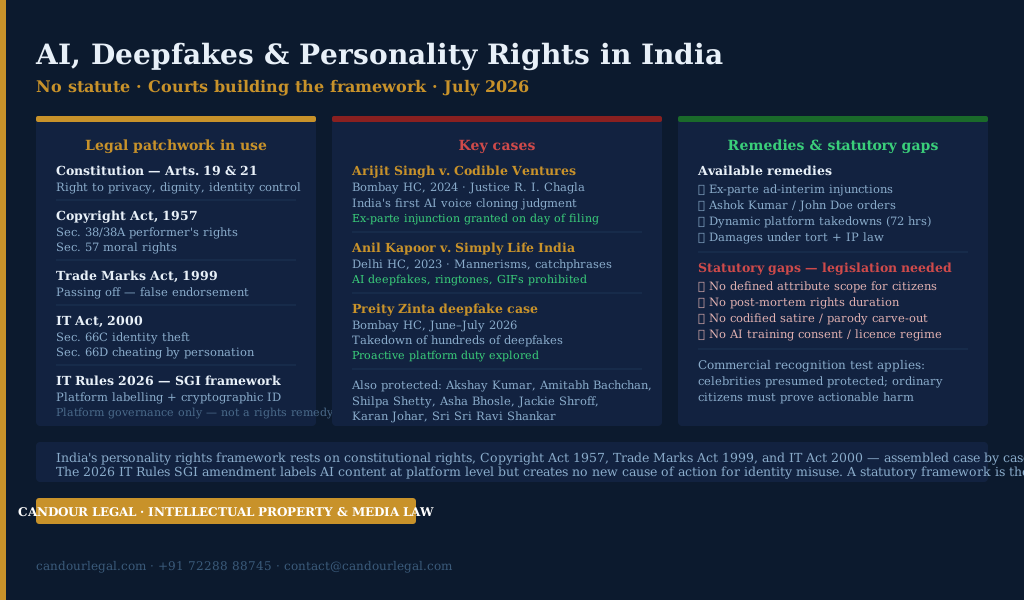
- India has no standalone personality rights statute. Courts have recognised and enforced personality rights through Articles 19 and 21 of the Constitution, the Copyright Act, 1957 (Sections 38, 38A, 57), the Trade Marks Act, 1999 (passing off), and the IT Act, 2000 (Sections 66C, 66D, 66E).
- Arijit Singh v. Codible Ventures LLP (Bombay High Court, Justice R. I. Chagla, 2024) is India’s first judgment directly addressing generative AI misuse against a named performer. The Court granted an ex-parte injunction against AI voice cloning, unauthorised merchandise, and false event associations, holding that such conduct threatened the performer’s career and livelihood.
- Courts apply a commercial recognition test: personality rights protection is stronger where the individual has acquired significant commercial value in their identity attributes — name, image, voice, likeness, mannerisms, catchphrases. Non-celebrities face a higher burden of establishing actionable harm.
- John Doe / Ashok Kumar orders against unknown AI infringers allow plaintiffs to subsequently implead identified defendants without fresh proceedings. Dynamic injunctions require platforms to take down identified content within 72 hours and block future infringing content proactively.
- The 2026 amendment to the IT Rules, 2021 introduced the Synthetically Generated Information (SGI) framework requiring platforms to label AI-generated content with disclosures and cryptographic identifiers. This is a platform-governance measure, not a personality rights remedy.
- The statutory vacuum produces four specific gaps: no clarity on which attributes are protected for ordinary citizens; no defined duration of rights after death; no codified exceptions for satire, parody, and news commentary; and no express consent-and-licensing regime for AI training on celebrity data.
- The Bombay High Court has granted protection to, among others, Akshay Kumar, Arijit Singh, Shilpa Shetty, Amitabh Bachchan, Asha Bhosle, and most recently Preity Zinta in cases arising from deepfakes, voice cloning, and AI-generated content. The Delhi High Court has granted protection to Anil Kapoor, Jackie Shroff, and Sri Sri Ravi Shankar in parallel proceedings.
The Statutory Landscape: What India Has and What It Lacks
Personality rights in India — defined as the right of an individual to control the commercial exploitation of their name, image, voice, likeness, mannerisms, signature, and other attributes of identity — are not the creature of any single statute. They have been assembled by courts from provisions scattered across four instruments.
The Copyright Act, 1957 provides two relevant heads. Section 38 and Section 38A govern performer’s rights, which include the right to prevent audio and video recording of performances and the communication of such recordings to the public without consent. Section 57 provides moral rights — the author’s right to claim authorship and to restrain distortion, mutilation, or modification of the work that is prejudicial to the author’s honour or reputation. In the AI context, courts have extended the performer’s rights framework to cover AI-generated voice cloning and synthetic recreations of performances, treating them as unauthorized reproductions of the performer’s attributes rather than original AI works.
The Trade Marks Act, 1999 provides a passing-off remedy where the unauthorized use of an individual’s name, image, or persona creates a false impression of endorsement or association with a commercial entity. The passing-off action has been the primary vehicle for claims involving AI-generated fake endorsements — deepfake videos showing a public figure appearing to endorse a product or service they have not endorsed create exactly the false representation that passing off is designed to restrain.
The Information Technology Act, 2000 provides criminal and civil remedies for identity theft through impersonation using a unique identification feature (Section 66C), cheating by personation using computer resources (Section 66D), and violation of privacy through electronic content (Section 66E). Indian courts have interpreted “unique identification feature” broadly to include facial geometry and voice biometrics, making AI-generated deepfakes and voice clones potential Section 66C violations.
Constitutional rights under Articles 19 and 21 provide the broadest foundation. Article 21 — the right to life and personal liberty — has been interpreted by the Supreme Court to include the right to privacy, the right to dignity, and, by extension, the right to control the commercial exploitation of one’s identity. Article 19(1)(a) guarantees freedom of speech and expression, creating a tension with personality rights claims that courts must balance: satire, parody, commentary, and journalism based on a public figure’s persona are protected expression; commercial exploitation of that persona for financial gain is not.
The Judicial Architecture: How Courts Are Building the Framework
The leading case is Arijit Singh v. Codible Ventures LLP (Bombay High Court, Justice R. I. Chagla, 2024). The case arose from systematic commercial exploitation of the playback singer’s identity: AI platforms generating voice content in his style, websites selling merchandise using his name and image, event promoters falsely associating their events with him, and domain name registrants occupying URLs incorporating his name. The Court granted an ex-parte ad-interim injunction on the day of filing, described the AI voice cloning as shocking the conscience of the Court, and held that the creation of new audio or video content in the plaintiff’s AI name, voice, photograph, image, likeness, and persona without consent and for commercial purposes could jeopardize the plaintiff’s career and livelihood. Arijit Singh is significant not merely for the relief granted but for the Court’s explicit engagement with the AI dimension — it is the first Indian judgment to identify generative AI as the specific threat and to frame the legal response in terms of its particular characteristics.
The Delhi High Court’s line of decisions runs in parallel. In Anil Kapoor v. Simply Life India & Ors. (2023), the Court extended protection beyond biometric identifiers to cover mannerisms, dialogue delivery, physical gestures, and catchphrases, explicitly prohibiting AI-generated deepfakes, ringtones, and GIFs. In Jackie Shroff v. The Peppy Store (2024), the Court restrained unauthorized use of the actor’s persona across online platforms and ordered blocking of infringing URLs. The Delhi High Court has since granted similar protection to Karan Johar (against identity misuse in online fundraising), Abhishek Bachchan (against unauthorized voice and image use), and Sri Sri Ravi Shankar (against deepfake and morphed content).
The Bombay High Court’s July 2026 order in the Preity Zinta deepfake case — reported the day this article is written — adds the latest layer. The Court directed takedown of hundreds of deepfake items documented by the plaintiff’s legal team and explored, for the first time in a reported proceeding, whether online intermediaries can develop proactive mechanisms for responding to future complaints rather than requiring victims to return to court each time new infringing content appears. That question — of platform-level proactive duty versus reactive takedown — is the next major frontier in the Indian personality rights jurisprudence.
John Doe Orders and Dynamic Injunctions: The Procedural Tools
The procedural architecture for personality rights enforcement in India has adapted to the anonymous, multi-defendant, multi-platform nature of AI-driven identity misuse. Two tools are central.
John Doe orders — called Ashok Kumar orders in Indian practice — are injunctions issued against unnamed or unidentified defendants. Courts issue these where the plaintiff knows their identity is being exploited but cannot identify all the infringers at the time of filing. The order allows the plaintiff to implead specific defendants as they are identified without returning to court for fresh relief. In AI deepfake cases, where content is created and shared by multiple anonymous users across Instagram, YouTube, Telegram, and smaller platforms simultaneously, the Ashok Kumar order is the only viable procedural mechanism at the interim stage.
Dynamic injunctions go further. Rather than ordering the takedown of a specific list of URLs, a dynamic injunction requires the platform to take down any content substantially similar to the identified infringing content as it appears in the future — without the plaintiff having to identify each new URL individually and return to court. Indian courts have issued dynamic injunctions in copyright and personality rights cases, typically directing large platforms to act within 72 hours of notification and requiring them to develop internal processes for blocking substantially similar content proactively.
The SGI Framework Under the 2026 IT Rules Amendment
The 2026 amendment to the IT Rules, 2021 introduced the Synthetically Generated Information (SGI) framework as the government’s first direct legislative response to deepfakes and AI-generated content. SGI is defined as audio, visual, or audio-visual content artificially or algorithmically created, modified, or altered using a computer resource in a manner that appears indistinguishable from a natural person or real-world event. Platforms permitting the creation or sharing of SGI must label all such content with prefixed text and audio disclosures and embed unique cryptographic identifiers traceable to the originating device.
The SGI framework is a platform-governance measure. It does not create a personality rights cause of action, does not establish a licensing regime for AI training on celebrity data, and does not define the attributes of identity that are protected. Its practical contribution is to make AI-generated content identifiable and traceable — which assists enforcement of existing rights rather than creating new ones. For a plaintiff seeking to establish that a deepfake video was created using their likeness without consent, the cryptographic identifier requirement provides a potential chain-of-custody from the content to the originating device.
The Statutory Gap: Four Problems a Personality Rights Act Would Solve
The judicial framework is functional but produces four persistent uncertainties that only legislation can resolve.
First, the attribute scope question. Courts have protected name, image, voice, vocal style, mannerisms, catchphrases, and AI-generated replicas for established celebrities. The scope of protection for ordinary citizens without commercial recognition remains undefined. A statute could codify a tiered approach: broader protection for identities with established commercial value, a lower threshold for non-consensual intimate content regardless of celebrity status.
Second, the post-mortem rights question. Personality rights in India have no defined duration after death. The Copyright Act provides moral rights protection for the author’s lifetime, but there is no comparable post-mortem personality rights framework. For deceased performers — particularly those whose voice or likeness is commercially valuable to AI training companies — the legal position is uncertain. The late Asha Bhosle’s case at the Bombay High Court touched on this question without conclusively resolving it.
Third, the satire and parody carve-out. Courts balance personality rights against Article 19(1)(a) on a case-by-case basis. A statutory framework with explicit carve-outs for satire, parody, news commentary, and academic use would reduce litigation uncertainty for creators who wish to engage critically or creatively with public figures’ personas without risking injunction.
Fourth, the AI training consent framework. The most commercially significant question is whether using a public figure’s voice recordings, video performances, or published images to train an AI model constitutes an actionable use of personality rights or performer’s rights without consent. Current Indian law provides no clear answer. A licensing regime — similar to what collecting societies provide for music performance rights — would enable commercial AI development while protecting the individuals whose data is being used.
Looking Ahead
The direction of Indian law on personality rights is clear: courts will continue to extend protection, the scope of protected attributes will expand, and platform liability will increase. The Preity Zinta order’s exploration of proactive platform duties signals that the next phase of jurisprudence may impose affirmative obligations on intermediaries rather than simply requiring them to respond to takedown notices. Against that trajectory, legislation that codifies the framework — protected attributes, consent requirements, permitted uses, platform obligations, and post-mortem rights — would reduce litigation burden, improve enforceability, and provide the statutory certainty that India’s AI industry needs to develop within a defined legal perimeter.
Frequently Asked Questions
What are personality rights in India?
Personality rights give individuals — most commonly public figures with significant commercial recognition — the right to control commercial use of their name, image, voice, likeness, mannerisms, and other identity attributes. India has no standalone personality rights statute. Courts have recognised these rights through the Copyright Act, 1957, the Trade Marks Act, 1999, the IT Act, 2000, and constitutional rights under Articles 19 and 21.
What is the Arijit Singh personality rights case?
In Arijit Singh v. Codible Ventures LLP (Bombay High Court, 2024), Justice R. I. Chagla granted an ex-parte injunction against AI voice cloning, unauthorised merchandise, false event associations, and infringing domain names using the playback singer’s identity. It is India’s first judgment directly addressing generative AI misuse against a named performer and established that AI voice cloning violates personality rights and can jeopardize the performer’s career and livelihood.
What legal remedies are available for AI deepfake misuse in India?
Courts have granted: ex-parte ad-interim injunctions against identified and unknown defendants; John Doe / Ashok Kumar orders against anonymous infringers; dynamic injunctions requiring platforms to take down identified content within 72 hours and block substantially similar content proactively; and injunctions under the Copyright Act, Trade Marks Act, and general tort law. Criminal remedies under Sections 66C and 66D of the IT Act are available for identity theft and cheating by personation.
Does the IT Rules 2026 amendment address AI deepfakes?
The 2026 amendment introduced the Synthetically Generated Information (SGI) framework, requiring platforms to label AI-generated content and embed cryptographic identifiers. It is a platform-governance measure, not a personality rights remedy. It does not create a cause of action for identity misuse, a licensing regime for AI training, or defined exceptions for satire and parody.
Who can claim personality rights protection in India?
Courts apply a commercial recognition test: protection is strongest for individuals whose identity attributes have acquired significant commercial value. Established entertainers, athletes, and public figures have succeeded consistently. Non-celebrities face a higher threshold and must establish clear economic or reputational harm without the presumption of commercial value that courts extend to established public figures.
What is a John Doe / Ashok Kumar order in an AI personality rights case?
An injunction against unnamed or unidentified defendants, issued where the plaintiff knows their identity is being exploited but cannot identify all the infringers. The order allows the plaintiff to implead specific defendants as they are identified, without returning to court for fresh relief. Essential in AI deepfake cases where content is created by multiple anonymous users across many platforms simultaneously.
Personality rights, deepfake, or AI identity misuse matter?
Candour Legal advises individuals, entertainers, brands, and platform operators on personality rights enforcement, AI content disputes, copyright and trade mark infringement, and interim injunction proceedings before the Delhi and Bombay High Courts.
About the author
Manasvi Thapar, Founding Advocate at Candour Legal, advises on intellectual property disputes, personality rights enforcement, media and entertainment law, and technology-related litigation before the High Courts.
Candour Legal is a full-service Indian law firm with offices in Ahmedabad, Mumbai, and New Delhi. More on our practice areas.
Further reading


Speak to a senior advocate about your matter.
Tell us what's going on. We review every enquiry personally and reply within 24 working hours.
Schedule a Consultation
Takes under a minute. We'll come back to you within 24 working hours.
Request received.
Thank you — a Candour Legal advocate will contact you within 24 working hours.
Urgent? Call us right away.
Disclaimer — Bar Council of India
As per the rules of the Bar Council of India, advocates and law firms are not permitted to solicit work or advertise. This website is intended solely to provide general information about Candour Legal and its areas of practice, and is made available to the user only at the user's own specific request. The contents of this website do not constitute, and should not be construed as, legal advice, an advertisement, a solicitation or an invitation of any kind. Candour Legal assumes no liability for any action taken in reliance on the material on this website; readers facing a legal issue should seek appropriate professional advice on their specific circumstances. Use of this website, or transmission of any enquiry through it, does not create a lawyer-client relationship between the user and Candour Legal.
BEFORE YOU GO
Get a free 15-minute case assessment
Tell us what's going on and a Candour Legal advocate will call you back — no charge, no obligation.
Schedule my free assessment Call now