


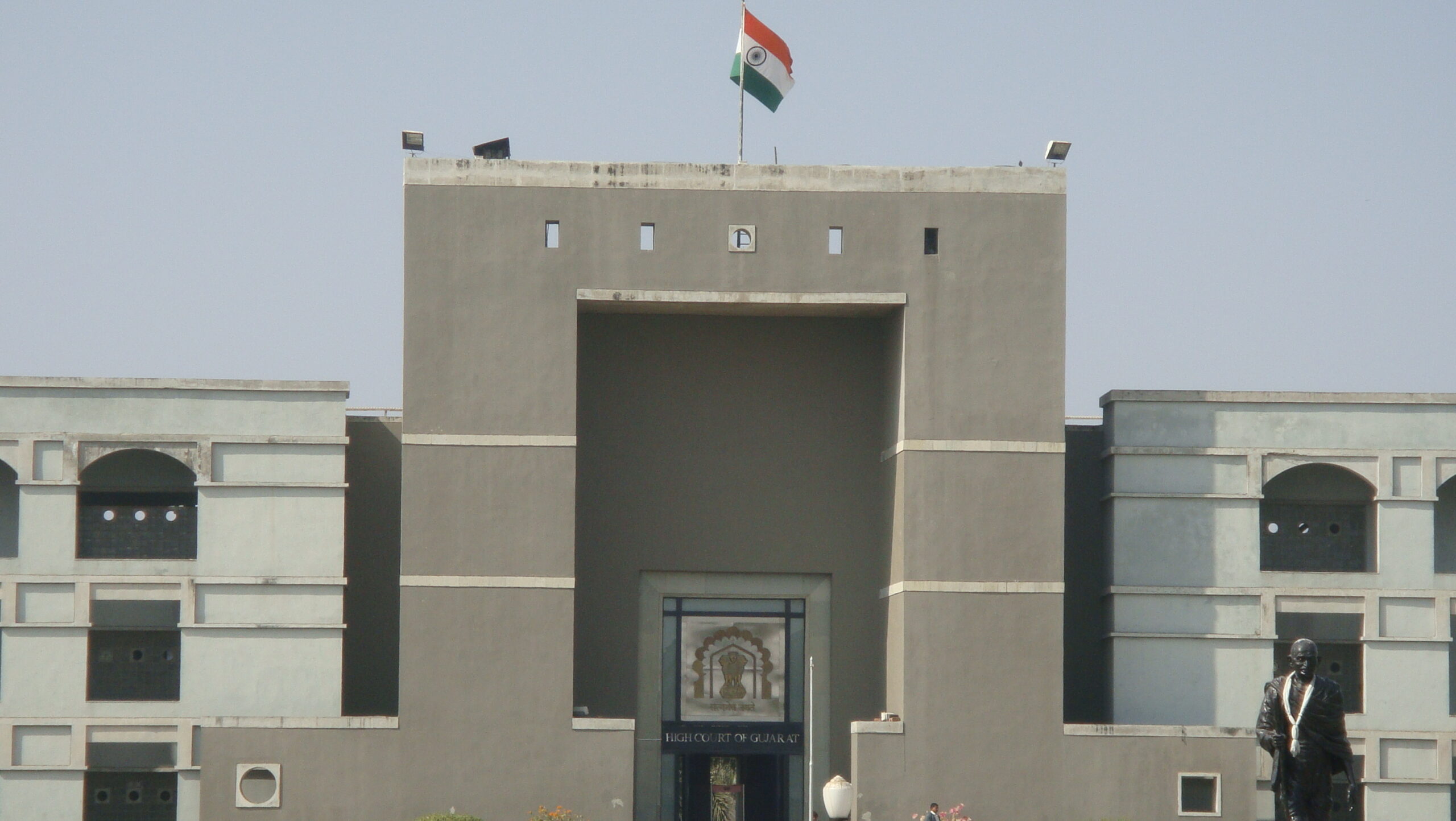
Gujarat High Court, Ahmedabad (3 January 2012). Photo: Maulik Kansara, “Gujarat High court.JPG”, via Wikimedia Commons, CC BY-SA 3.0. Resized for display.
What protection can be sought before arrest, which court can consider the application, and what the Gujarat High Court now requires in the filing.
Candour Legal | Legal source review: 25 November 2026
A person who reasonably apprehends arrest for a non-bailable offence may seek anticipatory bail under section 482 of the Bharatiya Nagarik Suraksha Sanhita, 2023 (BNSS), where that provision applies. The application is made to the High Court or the Court of Session. Relief depends on the accusation, the available record and the court’s assessment; filing an application does not itself provide protection against arrest.[1]
For a person facing an investigation in Ahmedabad or elsewhere in Gujarat, the immediate task is to identify the applicable procedure, assemble the relevant documents and state the relief required precisely.
First, identify the correct provision
Two provisions numbered ‘482’ concern different remedies. Section 482 BNSS concerns anticipatory bail. Section 482 of the earlier Code of Criminal Procedure, 1973 (CrPC), concerns the High Court’s inherent powers. The corresponding inherent-power provision under BNSS is section 528.[1]
This distinction matters when reading older judgments. A decision discussing quashing under section 482 CrPC should not be treated as a decision about anticipatory bail under section 482 BNSS.
The transitional position also requires care. BNSS section 531 preserves the earlier procedure for specified matters pending immediately before commencement. Counsel should examine the procedural history and relevant binding decisions before selecting the provision. The date of a new application, taken alone, should not substitute for that assessment.[1][2]
When can anticipatory bail be sought?
The apprehension of arrest must have a concrete basis connected with an identifiable accusation. A general fear of future complaints is insufficient.
In Sushila Aggarwal v State (NCT of Delhi), the Supreme Court explained that an application can precede registration of an FIR where clear facts provide a reasonable basis for apprehending arrest. The application must disclose the essential allegations and the applicant’s account.[3]
Sushila Aggarwal interpreted section 438 CrPC. Its principles are relevant to the corresponding BNSS scheme, subject to the current statutory text and applicable binding decisions.
A useful chronology identifies the alleged incident, police communications and the conduct attributed to that applicant. Where several people are named, their roles should be addressed individually.
Which court should consider the application?
Section 482 confers jurisdiction on the High Court and the Court of Session.[1] The filing decision requires attention to territorial jurisdiction, existing proceedings, previous applications and applicable court practice.
If relief was previously refused, withdrawn or limited, the record should include that order and address its effect. An earlier application should not disappear from the account merely because the next application is presented to a different court.
Candour Legal’s Gujarat High Court practice page provides the wider court context.
Gujarat High Court: the September 2026 disclosure requirements
The Gujarat High Court amended Rule 334 on 2 September 2026. The substituted proviso requires specified particulars in every memorandum of appeal or application for bail presented to the Court.[4]
The filing should address six groups of information:
- Case particulars: FIR number and date, police station, district, State, invoked provisions and maximum punishment.
- Custody: arrest date and custody already undergone.
- Proceedings: current stage and the prescribed prosecution-witness figures.
- Antecedents: other criminal cases, invoked provisions and their status.
- Earlier bail applications: the court, case number and outcome.
- Coercive process: non-bailable warrants and proclaimed-offender status.
For an anticipatory-bail applicant, some custody or trial particulars may not yet arise. The application should explain that position accurately. Before settling the papers, reconcile the chronology with the FIR, notices, previous applications and orders.
Advance service and filing preparation
Rule 335 requires service of the bail application on the Government Pleader at least 24 hours before hearing for cases arising from Ahmedabad City, and 48 hours for mofussil cases.[5]
Those periods concern service before the hearing. They do not state when a matter will be listed or how quickly the Court will decide it. Urgent presentation, listing and any requested interim relief must be considered against current administrative directions and the circumstances.
The Court’s notice dated 27 April 2026 states that amended A4-paper filing requirements apply from 1 August 2026.[6] Check the operative filing instructions when preparing the papers.
Documents worth assembling at the outset
Preparation should ordinarily include the available FIR or complaint, police notices, relevant orders and earlier bail applications. A dated chronology should distinguish the alleged incident from subsequent procedural steps.
Supporting documents should address the applicant’s actual role. Depending on the accusation, these may include employment records, company authorisations, contracts, payment records, correspondence or travel documents.
Each annexure should have an identifiable purpose. Counsel should be told about inconvenient documents and inconsistent earlier accounts before the application is finalised. Preserve electronic material in its available original form; a selected screenshot may omit relevant context.
What does the court consider?
Sushila Aggarwal identifies considerations including the nature and gravity of the offence, the applicant’s role, possible interference with the investigation or witnesses, and the risk of fleeing justice.[3]
The application should explain why protection is justified on the record. Statements that the applicant is respectable or falsely implicated should be supported by relevant facts. Material weaknesses in the accusation should be identified without treating a preliminary hearing as the completed trial.
Conditions, duration and continuing obligations
Conditions may require attendance for questioning, protection of witnesses from interference and permission before foreign travel.[1] Read the operative order carefully and keep a record of compliance.
Under Sushila Aggarwal, protection need not invariably expire after a fixed period or when charges are framed, although justified limits may be imposed. Protection remains tied to the identified accusation, investigation continues, and breach can lead to cancellation.[3]
Any uncertainty about a condition should be addressed through the appropriate legal process before acting on an assumption.
Exclusions and special criminal laws
Section 482 excludes accusations under section 65 and section 70(2) BNS.[1] Special legislation may introduce separate restrictions or conditions.
For example, section 37 of the NDPS Act imposes additional bail requirements for specified offences and cases involving commercial quantity.[7] A general anticipatory-bail explanation cannot resolve those matters without examining the particular statutory framework.
Candour Legal insight
The first decision should follow a review of what is alleged, which law governs, what has already happened and what protection is required now. A clear chronology and complete procedural history help identify the available remedy and the questions the court must answer.
This guide forms part of Candour Legal’s criminal litigation resources.
Key takeaways
- Identify the applicable BNSS or saved CrPC procedure before filing.
- Prepare the disclosures required by Gujarat High Court Rule 334 as amended in September 2026.
- Distinguish filing, interim protection and the final bail order; each has a different practical effect.
Frequently asked questions
Does filing an application stop arrest?
No. The application itself is not a protective order; any interim protection must be granted by the court.[1][3]
Can anticipatory bail be sought before an FIR?
It may be sought where concrete facts establish a reasonable apprehension relating to an identifiable accusation.[3]
Does anticipatory bail end the criminal case?
No. It concerns protection on the terms ordered; investigation and the appropriate subsequent proceedings can continue.[3]
Related resources: Criminal litigation in Ahmedabad and Gujarat · Gujarat High Court proceedings · Supreme Court criminal proceedings.
Contact
Candour Legal | Ahmedabad, Gujarat. Contact page · contact@candourlegal.com · WhatsApp: +91 9328162446.
This article provides general legal information. The appropriate remedy depends on the facts, applicable law and procedural history.
Primary sources
The following primary materials were reviewed on 25 November 2026. Detailed filing requirements should be checked against the operative rules and directions when proceedings are prepared.
- Bharatiya Nagarik Suraksha Sanhita, 2023 — official Gazette
- BNSS commencement notification — S.O. 848(E), 23 February 2024
- Sushila Aggarwal v State (NCT of Delhi), (2020) 5 SCC 1 — Constitution Bench judgment, 29 January 2020
- Gujarat High Court (Amendment) Rules, 2026, No. 3 — 2 September 2026
- Gujarat High Court Rules, 1993 — official compilation amended as on 2 April 2026
- Gujarat High Court A4-paper implementation notice — 27 April 2026
- Narcotic Drugs and Psychotropic Substances Act and Rules — Central Bureau of Narcotics, updated 2025


Speak to a lawyer
Tell us what's going on. We review every enquiry personally and reply within 24 working hours.
Schedule a Consultation
Takes under a minute. We'll come back to you within 24 working hours.
Request received.
Thank you — a Candour Legal advocate will contact you within 24 working hours.
Urgent? Call us right away.
Disclaimer — Bar Council of India
As per the rules of the Bar Council of India, advocates and law firms are not permitted to solicit work or advertise. This website is intended solely to provide general information about Candour Legal and its areas of practice, and is made available to the user only at the user's own specific request. The contents of this website do not constitute, and should not be construed as, legal advice, an advertisement, a solicitation or an invitation of any kind. Candour Legal assumes no liability for any action taken in reliance on the material on this website; readers facing a legal issue should seek appropriate professional advice on their specific circumstances. Use of this website, or transmission of any enquiry through it, does not create a lawyer-client relationship between the user and Candour Legal.
BEFORE YOU GO
Get a free 15-minute case assessment
Tell us what's going on and a Candour Legal advocate will call you back — no charge, no obligation.
Schedule my free assessment Call nowHave a legal enquiry? Share a brief outline with our team on WhatsApp.
Continue in WhatsApp ↗Email our team ↗Email opens your email app; review and press Send. WhatsApp opens WhatsApp. Please avoid sending confidential documents before we confirm that we can act.Have a legal enquiry? Share a brief outline with our team on WhatsApp.
Continue in WhatsApp ↗Email our team ↗Email opens your email app; review and press Send. WhatsApp opens WhatsApp. Please avoid sending confidential documents before we confirm that we can act.Have a legal enquiry? Share a brief outline with our team on WhatsApp.
Continue in WhatsApp ↗Opens WhatsApp. Please avoid sending confidential documents before we confirm that we can act.