


By Candour Legal Team · Legal position reviewed on 14 November 2026
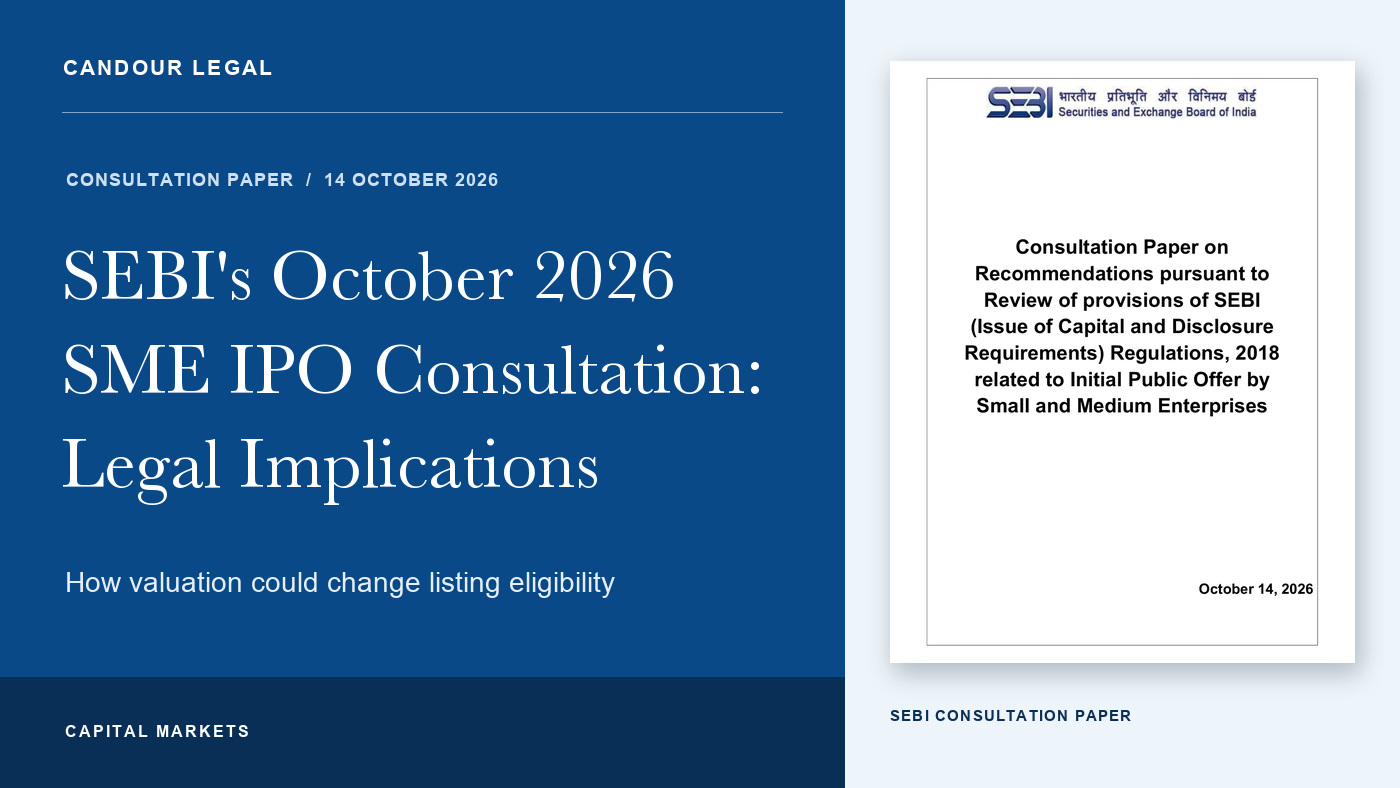
On 14 October 2026, the Securities and Exchange Board of India (SEBI) proposed using an issuer’s post-issue market capitalisation to decide which IPO platform it can access. Its SME IPO consultation also proposes a new operating-profit test, an institutional route for issuers that miss it, and different reporting requirements for larger companies choosing an SME listing. SEBI’s consultation paper of 14 October 2026.
What applies to a filing today? As of 14 November 2026, issuers must apply Chapter IX of the SEBI (Issue of Capital and Disclosure Requirements) Regulations, 2018 (ICDR Regulations), and the chosen exchange’s admission requirements. The paper gave 4 November as its original deadline for comments. A binding change requires a notified amendment and attention to its commencement and transition provisions. ICDR Regulations, Chapter IX · SEBI consultation, §7.1.
Why SEBI is reviewing the SME IPO framework
Two businesses with similar paid-up capital may have very different valuations. A software company can build a valuable business without issuing much nominal capital. Another company may have more paid-up capital despite operating on a smaller scale. This matters because paid-up capital currently determines access to the SME segment. SEBI’s figures show the range the segment now serves. SEBI consultation, §§3–4.
| Measure | Total |
|---|---|
| Entities listed on SME platforms since inception, including those that migrated | 1,496 |
| Companies that migrated to the main board | 365 |
| Funds raised through SME IPOs since inception | ₹40,222 crore |
| Market capitalisation of the entities, including those that migrated | ₹4,70,984 crore |
For background on the two domestic SME platforms and the role of Chapter IX, see Candour Legal’s legal framework for SME IPOs in India.
How valuation would affect the listing route
Regulation 229(1) currently covers post-issue paid-up capital up to ₹10 crore. Under regulation 229(2), an issuer above ₹10 crore and up to ₹25 crore may also use Chapter IX. SEBI proposes measuring post-issue share capital at the offer price. An issuer would therefore need to revisit the calculation as pricing changes. ICDR Regulations, reg. 229(1)–(2) · SEBI consultation, §5.1.1.
| Post-issue market capitalisation | Route proposed by SEBI |
|---|---|
| Up to and including ₹1,000 crore | SME platform only. |
| Above ₹1,000 crore and up to and including ₹4,000 crore | Choice of main board or SME platform, subject to the applicable admission conditions. Choosing SME would bring an additional Ind AS requirement. |
| Above ₹4,000 crore | Main-board route, subject to main-board eligibility. |
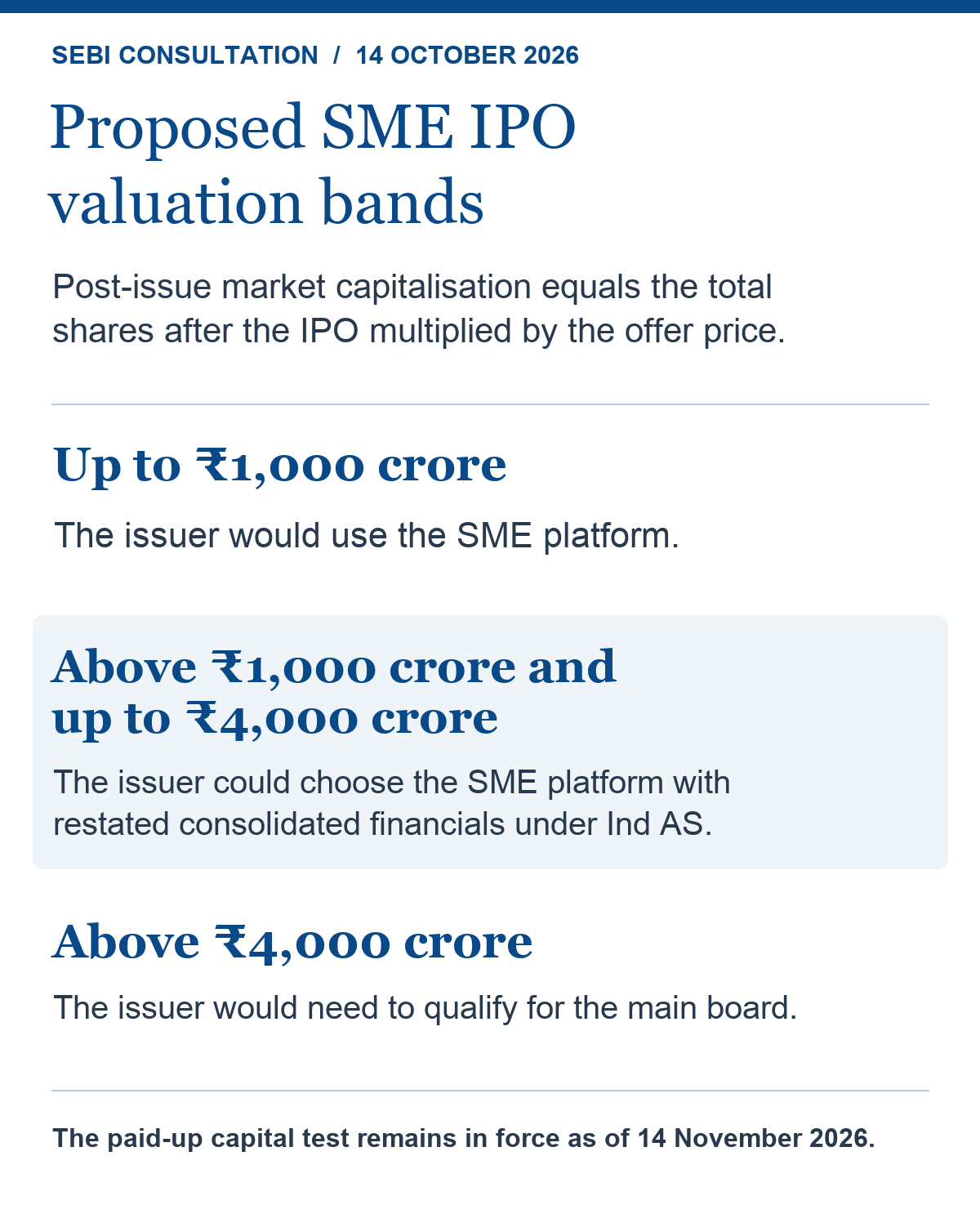
The draft would test the route again when the issuer files its red herring prospectus (RHP) for a book-built issue or its prospectus for a fixed-price issue. A main-board applicant falling to ₹1,000 crore or less would refile under Chapter IX. An SME applicant moving above ₹1,000 crore could remain on the SME platform up to ₹4,000 crore. Above that ceiling it would refile under the main-board framework. SEBI consultation, §5.1.1.7 and proposed Schedule XVI clauses.
For example, an issuer with ten crore post-issue shares would be valued at ₹990 crore at ₹99 a share and ₹1,010 crore at ₹101. That small pricing change would put the issuer into the optional band. When setting the indicative price range, the board and merchant banker should record which filings and financial statements each price would require. This is a planning exercise under the proposal.
Ind AS reporting for larger SME issuers
An issuer choosing the SME platform in the optional band would need restated consolidated financial statements prepared under Indian Accounting Standards (Ind AS) for the preceding three financial years and any stub period. An issuer which has yet to adopt Ind AS would have to do so. Management should identify the subsidiaries and historical records needed for consolidation before fixing the filing date. Reporting accountants can then estimate the work, and counsel can reflect any material changes in the offer document. SEBI consultation, §5.1.1.6.
The proposed profitability test and institutional alternative
Regulation 229(6) currently requires operating profit from operations of at least ₹1 crore in at least two of the three preceding financial years, measured before interest, depreciation and tax. The proposed standard test is an annual average operating profit of at least ₹3 crore over the preceding three financial years, calculated on restated consolidated accounts. A business with qualifying operating profits of ₹2 crore in each of three years would clear today’s profit threshold but fall short of the proposed average. Other admission tests would still apply. ICDR Regulations, reg. 229(6) · SEBI consultation, §5.1.3.6.
Proposed regulation 229(7) would allow an otherwise eligible issuer that misses the profit test to undertake a book-built issue. Qualified institutional buyers (QIBs) would have to receive at least 75% of the net offer. If the issuer failed to achieve that allotment, it would refund the entire subscription. Requirements under regulations 229(3), (4) and (5), including those concerning operating history and promoter continuity, would still apply. A merchant banker assessing this route should test institutional demand and account for the full-refund scenario in the issue timetable. SEBI consultation, §5.1.4.
Conversion, restructuring and business continuity
Under current regulation 229(4), an issuer converted from a proprietorship, partnership or limited liability partnership (LLP) must have existed for at least one full financial year before filing its draft offer document. A conversion shortly after the start of a financial year can therefore produce a wait of nearly two years. ICDR Regulations, reg. 229(4).
SEBI proposes four consecutive completed financial quarters from conversion or the latest effective date of a qualifying reorganisation. Before filing its draft, the issuer would also have to file at least one post-transaction annual audited financial statement, or part of one, with the Registrar of Companies. The proposal would extend to reorganisations where more than half of the issuer’s latest financial-year revenue shown in the draft comes from one or more predecessor proprietorships, firms or LLPs. Their operating history would count towards Chapter IX eligibility. Identify the effective dates, trace the revenue and reconcile transferred assets, liabilities, contracts and licences to the accounts. SEBI consultation, §5.1.2.
NSE Emerge, BSE SME and the evidence to assemble before filing
Check the exchange’s own rules when selecting a platform. For example, NSE Emerge’s standard SME criteria include positive net worth and positive free cash flow to equity in at least two of the three financial years preceding the application. Its April 2026 circular explains which capital proceeds enter the free-cash-flow calculation. A company considering BSE SME should check BSE’s applicable notices and admission criteria for its filing date. NSE Emerge eligibility criteria · NSE circular of 20 April 2026 · BSE SME eligibility notice.
A company may satisfy a financial test and still face a delay if an allotment is undocumented, a lender’s consent is outstanding or a material dispute has been omitted. For the legal adviser’s role in preparing and verifying a draft red herring prospectus (DRHP), see Candour Legal’s IPO and capital markets practice.
- Record current eligibility. Have the company secretary and merchant banker reconcile post-issue paid-up capital, financial history, promoter changes and the chosen exchange’s conditions against supporting documents.
- Model the proposed routes. Have the CFO calculate market capitalisation across the price band. Compare the current profit test with the proposed three-year average and identify any need for Ind AS accounts or a revised timetable.
- Trace business continuity. Compile the conversion or transfer documents, relevant court or board approvals, Registrar filings, predecessor accounts and the revenue reconciliation.
- Verify the offer document. Reconcile share allotments, pledges, related parties and use of proceeds. Check licences, land, intellectual property, material contracts, litigation and contingent liabilities against the draft disclosures.
- Recheck before the RHP or prospectus. Refresh the price calculation and material disclosures, confirm board and shareholder approvals and check for any notified commencement or transition provisions. Assign responsibility for post-listing disclosures.
What to watch before the next filing
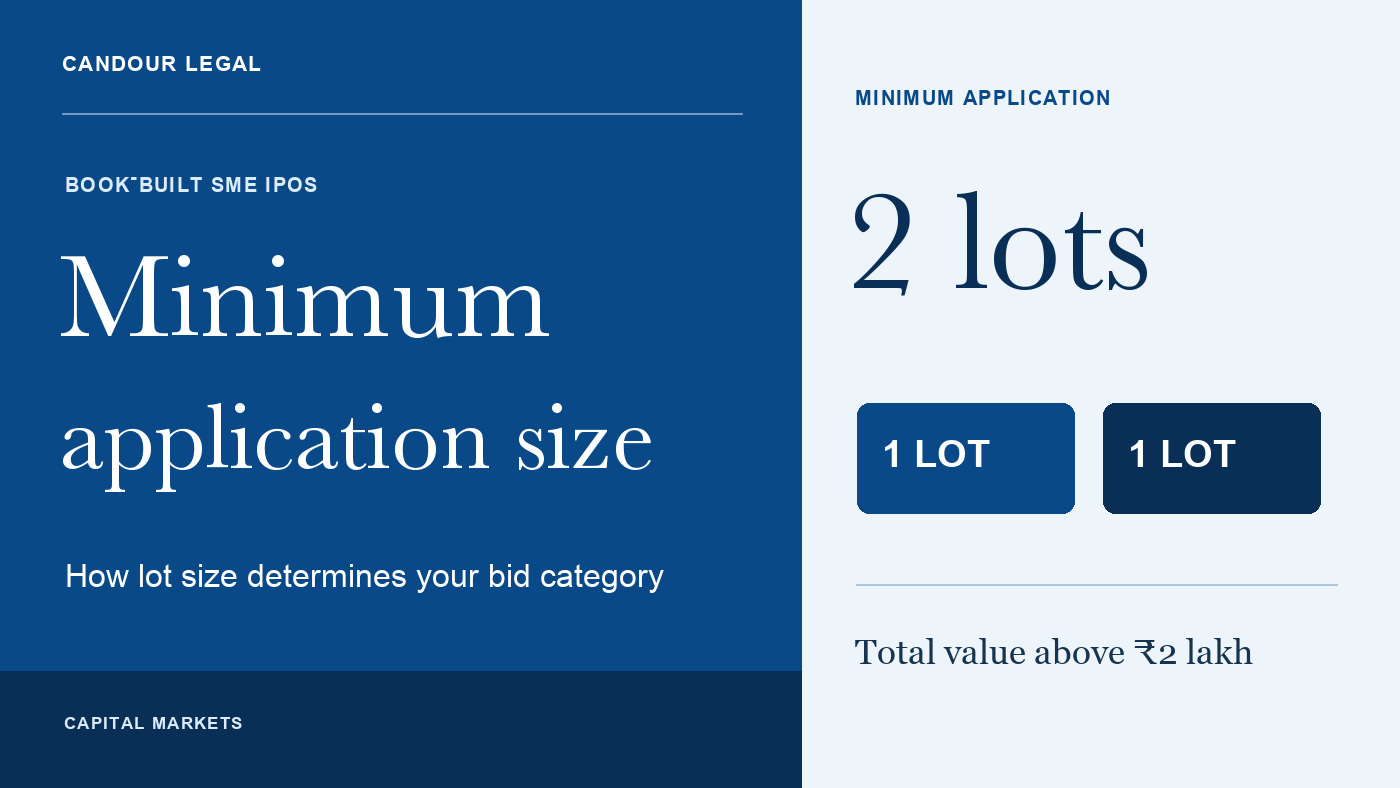
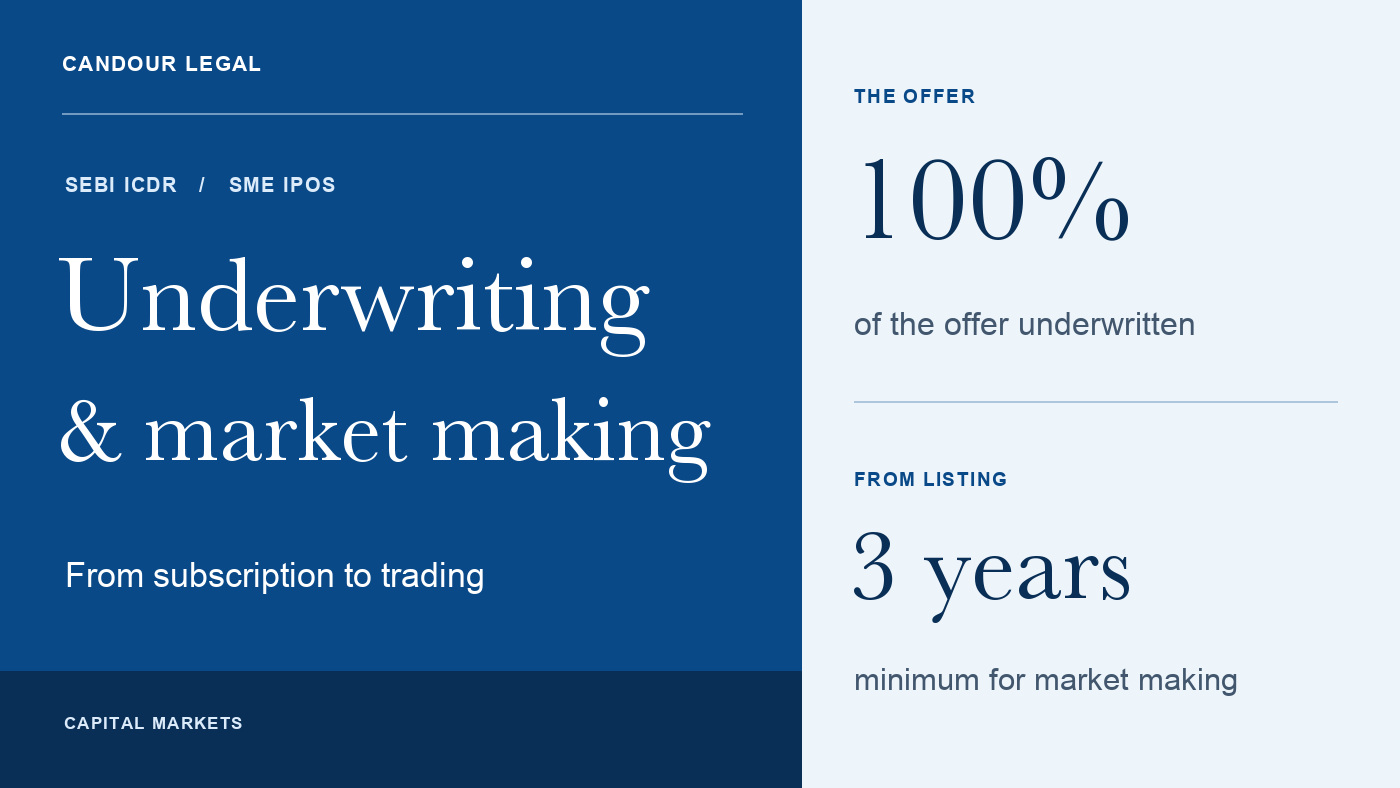
The immediate decision for a board is whether its chosen platform, accounts and disclosures support an application under today’s rules. Recording how a price change or a profit restatement would affect the route gives directors a practical basis to revisit that decision if SEBI adopts the reforms. The paper also addresses offer structure, trading lots, market making and migration. Its annexed comparison sets those proposals alongside the main-board framework. SEBI consultation, Annexure 1.
Frequently asked questions
What is SEBI’s October 2026 SME IPO consultation?
SEBI’s paper of 14 October 2026 asks how India should regulate SME public offers as issuers grow. It covers platform eligibility, profitability, issue structure, trading and migration to the main board.
Have the proposed SME IPO rules come into force?
As of 14 November 2026, the existing ICDR Regulations and applicable exchange requirements govern filings. The October paper proposes amendments. It gave 4 November 2026 as its original deadline for comments.
What is the proposed ₹1,000 crore threshold?
Under the proposal, an issuer with post-issue market capitalisation of ₹1,000 crore or less, calculated at the offer price, would use the SME route. Eligibility would be checked again when the red herring prospectus or fixed-price prospectus is filed.
Could a company valued above ₹1,000 crore use the SME platform?
An issuer above ₹1,000 crore and up to ₹4,000 crore could choose the SME platform under the proposal, subject to the applicable conditions, including Ind AS reporting. Above ₹4,000 crore, an issuer pursuing an IPO would need the main-board route and would have to meet its conditions.
What operating profit would an SME issuer need?
The proposed standard route would require average annual operating profit of at least ₹3 crore over the preceding three financial years, using restated consolidated accounts. A separate proposed book-built route would require at least 75% of the net offer to be allotted to qualified institutional buyers, alongside the other eligibility conditions.
Would all SME issuers have to adopt Ind AS?
The additional requirement in this proposal concerns issuers choosing the SME platform with post-issue market capitalisation above ₹1,000 crore and up to ₹4,000 crore. They would present restated consolidated Ind AS financial statements for three financial years and any stub period.
What does an IPO legal adviser check before filing?
Counsel verifies the issuer’s capital history, promoter interests, litigation, licences, material contracts and corporate approvals against the draft offer document. The merchant banker and reporting accountants also need the evidence supporting the chosen listing route and financial disclosures.
Should an issuer postpone filing because of the consultation?
The paper sets no general requirement to postpone an IPO. Assess readiness under the law in force, model the effect of the proposals, and revisit timing if SEBI notifies a change that applies to the transaction.
This article provides general legal information. An issuer should assess its own facts and the rules applicable on its filing date.
Speak to a senior advocate about your matter.
Tell us what's going on. We review every enquiry personally and reply within 24 working hours.
Schedule a Consultation
Takes under a minute. We'll come back to you within 24 working hours.
Request received.
Thank you — a Candour Legal advocate will contact you within 24 working hours.
Urgent? Call us right away.
Disclaimer — Bar Council of India
As per the rules of the Bar Council of India, advocates and law firms are not permitted to solicit work or advertise. This website is intended solely to provide general information about Candour Legal and its areas of practice, and is made available to the user only at the user's own specific request. The contents of this website do not constitute, and should not be construed as, legal advice, an advertisement, a solicitation or an invitation of any kind. Candour Legal assumes no liability for any action taken in reliance on the material on this website; readers facing a legal issue should seek appropriate professional advice on their specific circumstances. Use of this website, or transmission of any enquiry through it, does not create a lawyer-client relationship between the user and Candour Legal.
BEFORE YOU GO
Get a free 15-minute case assessment
Tell us what's going on and a Candour Legal advocate will call you back — no charge, no obligation.
Schedule my free assessment Call now