Candour Legal – Best Lawyers in Ahmedabad | Law firm in Ahmedabad





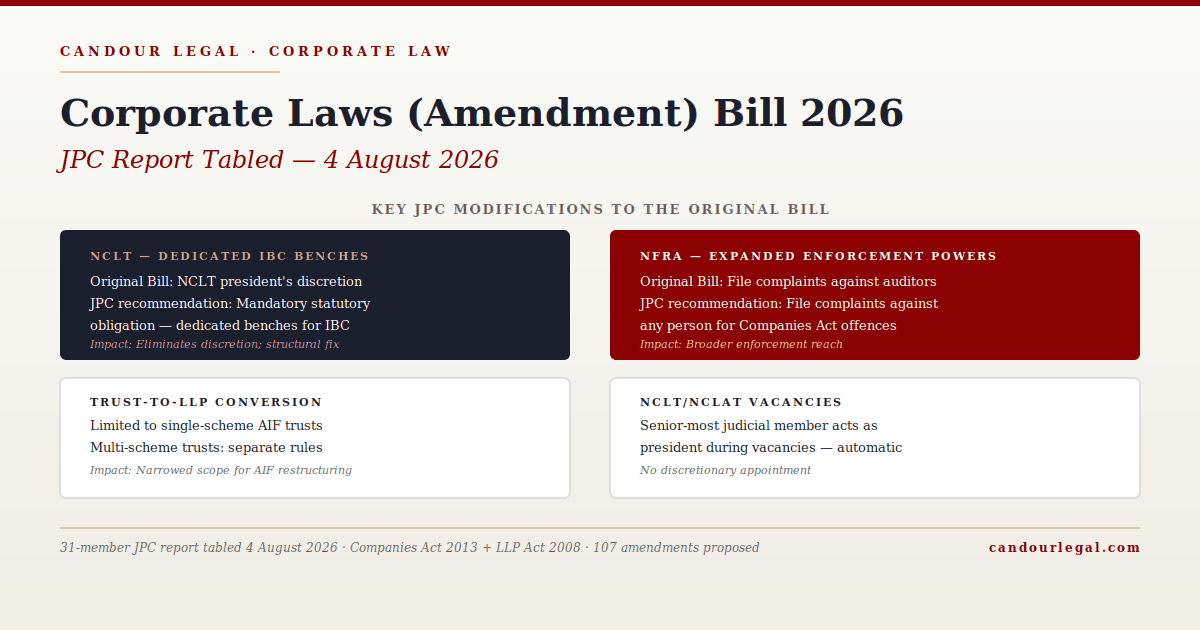
The Joint Parliamentary Committee on the Corporate Laws (Amendment) Bill, 2026 tabled its report in Parliament on 4 August 2026 — a 31-member committee that has spent several months examining a Bill proposing 107 amendments to the Companies Act, 2013 and the Limited Liability Partnership Act, 2008. The JPC has recommended adoption of the Bill with clause-wise modifications. Two of those modifications have immediate operational significance: the recommendation that dedicated insolvency benches at the National Company Law Tribunal (NCLT) be made a mandatory statutory obligation rather than an enabling provision, and the recommendation that the National Financial Reporting Authority (NFRA) be empowered to file complaints against any person — not merely auditors — for offences under the Companies Act. The path from JPC report to enacted statute now depends on the Monsoon Session calendar, but the report’s recommendations define the likely shape of Indian corporate law for the next cycle.
Key Takeaways
- The JPC tabled its report on 4 August 2026, recommending adoption of the Corporate Laws (Amendment) Bill, 2026 with clause-wise modifications.
- The Bill was introduced in Lok Sabha on 23 March 2026, proposing 107 amendments to the Companies Act, 2013 and the LLP Act, 2008.
- Most consequential JPC modification: dedicated IBC/insolvency benches at NCLT made a mandatory statutory obligation — the original Bill left this to the NCLT president’s discretion.
- NFRA empowered under the JPC recommendation to file complaints against any person liable under the Companies Act — broader than the original Bill’s auditor-focused scope.
- The executive discretion phrase “as may be prescribed” is recommended for deletion from several provisions, producing a more rule-certain statutory framework.
- Trust-to-LLP conversion limited to single-scheme AIF trusts — multi-scheme trusts subject to separate rules to be prescribed.
- NCLT/NCLAT vacancies: senior-most judicial member acts as president during vacancies — discretionary appointment provision removed by JPC.
- The CSR exemption clause (allowing Central Government to exempt certain companies from CSR requirements) is retained despite opposition criticism.
- Monsoon Session passage is possible; Budget Session 2027 is the outer timeline.
The Original Bill and What the JPC Changed
The Corporate Laws (Amendment) Bill, 2026 was introduced in March 2026 as a broad modernisation exercise — decriminalising technical defaults, transforming NFRA into an enforcement-driven regulator, designating IBBI as the unified valuation authority, enabling fast-track merger routes, and reworking the NCLT merger process to a single-bench model. The JPC’s mandate was not to rewrite the Bill but to examine its provisions against stakeholder input and recommend modifications. The committee received representations from government departments, regulators, industry bodies, legal experts, and professional institutes before finalising its report.
| Issue | Original Bill | JPC Recommendation |
|---|---|---|
| IBC / insolvency benches at NCLT | NCLT president’s discretion to constitute Special Benches | Mandatory statutory obligation — dedicated benches for IBC |
| NFRA complaint powers | File complaints against auditors / audit firms | File complaints against any person for Companies Act offences |
| Trust-to-LLP conversion | Allowed for AIF trusts generally | Limited to single-scheme AIF trusts; separate rules for multi-scheme |
| NCLT/NCLAT vacancy | Central Government nominates acting president | Senior-most judicial member becomes acting president — automatic |
| “As may be prescribed” phrase | Present in several provisions | Recommended for deletion — reduces executive discretion |
| CSR exemption for certain companies | Allows Central Government to exempt via prescribed rules | Retained — opposition criticism noted, not accepted |
NCLT Dedicated IBC Benches: From Optional to Mandatory
The most debated provision in the original Bill was its approach to dedicated IBC benches at NCLT. The original text allowed — but did not require — the NCLT president to constitute Special Benches for IBC cases. The JPC has accepted the position that this should be a statutory obligation rather than a presidential discretion. The NCLT’s institutional architecture has been a persistent bottleneck in IBC administration — cases have been delayed by bench unavailability, cross-listing between company-law and insolvency benches, and the concentration of IBC workload in a small number of benches (principally Mumbai, Delhi, Ahmedabad, and Chennai). Making dedicated benches mandatory creates a structural obligation that a future NCLT president cannot depart from by administrative preference.
For IBC practitioners, the implications are significant. Dedicated IBC benches mean judges with concentrated insolvency exposure — which over time produces a more consistent and predictable jurisprudence. The NCLT Ahmedabad bench, which handles a substantial volume of Gujarat-based real estate and MSME insolvencies, stands to benefit from dedicated resourcing. The change also interacts with the Supreme Court’s ruling in Tejas J. Shah (2026 INSC 746, decided 27 July 2026) on the Section 14 IBC moratorium — a more institutionally resourced NCLT will be better placed to manage the bifurcated proceedings that the Supreme Court’s ruling will generate. For the full analysis of that judgment, see our piece on IBC Section 14 moratorium and promoter liability.
NFRA: From Auditor Regulator to Broader Enforcement Authority
The JPC has gone further than the original Bill on NFRA’s enforcement powers. The original Corporate Laws (Amendment) Bill, 2026 significantly expanded NFRA’s enforcement powers, consistent with the government’s intent to transform NFRA from a passive standard-setter into an active enforcement-driven regulator. The JPC recommendation extends NFRA’s complaint-filing power to “any person” liable under the Companies Act — bringing company management, directors, and potentially promoters within NFRA’s enforcement purview, beyond its current auditor-focused jurisdiction.
The practical effect depends on the subordinate legislation that will define NFRA’s complaint-filing procedure, but the direction is clear: NFRA is being positioned as a financial reporting enforcement authority with jurisdiction over the full range of parties involved in a company’s financial reporting — not just the auditors who certify it. For compliance counsel advising company boards on audit committee oversight, NFRA’s expanded reach is a material risk factor that should be reflected in board-level governance frameworks.
Trust-to-LLP Conversion: Narrowed but Preserved
The original Bill included a trust-to-LLP conversion mechanism — primarily relevant for Category II and Category III AIFs structured as trusts that wished to convert to LLP format for operational or investor preference reasons. The JPC has modified the scope: conversion is now limited to single-scheme AIF trusts, with multi-scheme AIF trusts subject to separate rules to be prescribed. This narrowing reflects the JPC’s concern about the complexity of multi-scheme trust conversions — where unit-holder consent, scheme-specific asset allocation, and regulatory approval processes interact in ways that a single statutory conversion mechanism cannot adequately address.
For AIF managers operating multi-scheme trusts, the practical message is that the conversion route will not be available under the main Bill provision — they will need to wait for the separately prescribed rules, the timeline for which is not yet announced. Single-scheme AIF managers should begin reviewing conversion eligibility and unit-holder consent requirements in anticipation of the enacted framework.
The “As May Be Prescribed” Deletion
One of the JPC’s less-publicised but operationally significant recommendations is the deletion of the phrase “as may be prescribed” from several provisions. This phrase — common in Indian statutes — allows the Central Government to define operative conditions through subordinate legislation rather than fixing them in the parent Act. While this provides flexibility, it also generates uncertainty: practitioners cannot advise definitively on the scope of a provision until the prescribing rules are notified, which can take months or years. Where the JPC’s deletion recommendation is accepted in the final enacted text, the statutory provision becomes self-executing — producing a more rule-certain framework at the cost of some executive adaptability.
Looking Ahead
The Bill now proceeds to the full House for consideration and passage. A Monsoon Session passage is possible; the Budget Session 2027 is the outer timeline if the current session’s schedule is disrupted. Practitioners should note that the enacted Bill may differ from both the March 2026 version and the JPC’s recommendations — floor amendments remain possible. The provisions most likely to attract floor debate are the CSR exemption clause and the NFRA complaint-filing expansion. The transition provisions — governing ongoing NCLT proceedings, existing valuer registrations, and pending auditor disciplinary matters — will be critical in the enacted text and warrant close reading once available.
Frequently Asked Questions
What did the JPC recommend for NCLT insolvency benches?
The JPC recommended that dedicated IBC/insolvency benches at NCLT be made mandatory, rather than being left to the NCLT president’s discretion as the original Bill proposed. This creates a statutory obligation to constitute Special Benches for insolvency matters at every NCLT location.
What new powers does the JPC recommend for NFRA?
The JPC recommends empowering NFRA to file complaints before a competent court against any person liable under the Companies Act — not just auditors. This expands NFRA’s enforcement reach beyond its current auditor-focused jurisdiction to include company management, directors, and promoters.
What happened to the trust-to-LLP conversion provision?
The JPC has limited trust-to-LLP conversion to single-scheme AIF trusts. Multi-scheme AIF trusts will be subject to separate rules to be prescribed, placing them outside the main Bill provision.
Has the Corporate Laws (Amendment) Bill, 2026 been enacted?
No. The JPC tabled its report on 4 August 2026. The Bill must now be considered and passed by both Houses of Parliament. Passage is expected in the current Monsoon Session or the Budget Session 2027.
What does the deletion of “as may be prescribed” mean in practice?
Where the JPC recommends deleting this phrase, the statutory provision becomes self-executing — it does not require subordinate rules to define its operative scope. This reduces regulatory uncertainty but also limits the government’s ability to adapt the provision through rules without amending the parent Act.
How does this Bill interact with the Companies Act 2013 merger framework?
The original Bill’s single-bench NCLT reform for merger applications under Sections 230–232 remains part of the Bill and is expected to be retained in the enacted version. This will significantly compress deal timelines for mergers currently requiring multi-bench filings.
Speak to Candour Legal’s Corporate Law Team
Candour Legal advises corporates, founders, investors, and professional firms on Companies Act compliance, NCLT proceedings, mergers, demergers, LLP structuring, AIF governance, and the evolving corporate governance framework. The firm handles NCLT Ahmedabad matters and provides Gujarat-specific corporate, M&A, and restructuring advisory.
Schedule a 30-minute strategy callAbout the author
Manasvi Thapar, Advocate at Candour Legal, handles corporate litigation, NCLT proceedings, and commercial disputes. Schedule a call with Manasvi.
Candour Legal is a full-service Indian law firm with offices in Ahmedabad, Mumbai, and New Delhi. More on our Corporate Law practice.
Further reading

Speak to a senior advocate about your matter.
Tell us what's going on. We review every enquiry personally and reply within 24 working hours.
Schedule a Consultation
Takes under a minute. We'll come back to you within 24 working hours.
Request received.
Thank you — a Candour Legal advocate will contact you within 24 working hours.
Urgent? Call us right away.
Disclaimer — Bar Council of India
As per the rules of the Bar Council of India, advocates and law firms are not permitted to solicit work or advertise. This website is intended solely to provide general information about Candour Legal and its areas of practice, and is made available to the user only at the user's own specific request. The contents of this website do not constitute, and should not be construed as, legal advice, an advertisement, a solicitation or an invitation of any kind. Candour Legal assumes no liability for any action taken in reliance on the material on this website; readers facing a legal issue should seek appropriate professional advice on their specific circumstances. Use of this website, or transmission of any enquiry through it, does not create a lawyer-client relationship between the user and Candour Legal.
BEFORE YOU GO
Get a free 15-minute case assessment
Tell us what's going on and a Candour Legal advocate will call you back — no charge, no obligation.
Schedule my free assessment Call now