


By Candour Legal Team · Legal position reviewed on 14 November 2026
A profitable company can still miss NSE Emerge IPO eligibility because it has spent heavily on plant, repaid borrowings or recently changed promoters. For the standard SME IPO route, an Indian-incorporated company must satisfy the National Stock Exchange of India’s admission criteria and Chapter IX of SEBI’s Issue of Capital and Disclosure Requirements Regulations, 2018 (ICDR Regulations). The assessment begins before the draft red herring prospectus (DRHP) and continues through the final filing. NSE Emerge eligibility criteria · ICDR Regulations, regs. 227–230.
The financial and operating tests for the standard SME route
| Check | What to establish |
|---|---|
| Capital | Post-issue paid-up capital at face value of ₹25 crore or less. Reconcile the proposed fresh allotment to the pre-issue share register. |
| Track record | At least three years through the applicant, eligible promoters or promoting company, or a qualifying predecessor proprietorship or partnership converted into the applicant. |
| Operating profit | At least ₹1 crore from operations in any two of the previous three financial years, measured before interest, depreciation and tax. |
| Net worth | Positive net worth. Reconcile the figure to the accounts and explain material restatement adjustments. |
| Free cash flow to equity (FCFE) | Positive FCFE in at least two of the three financial years before the application. Prepare a separate calculation for each year. |
How to test post-issue paid-up capital
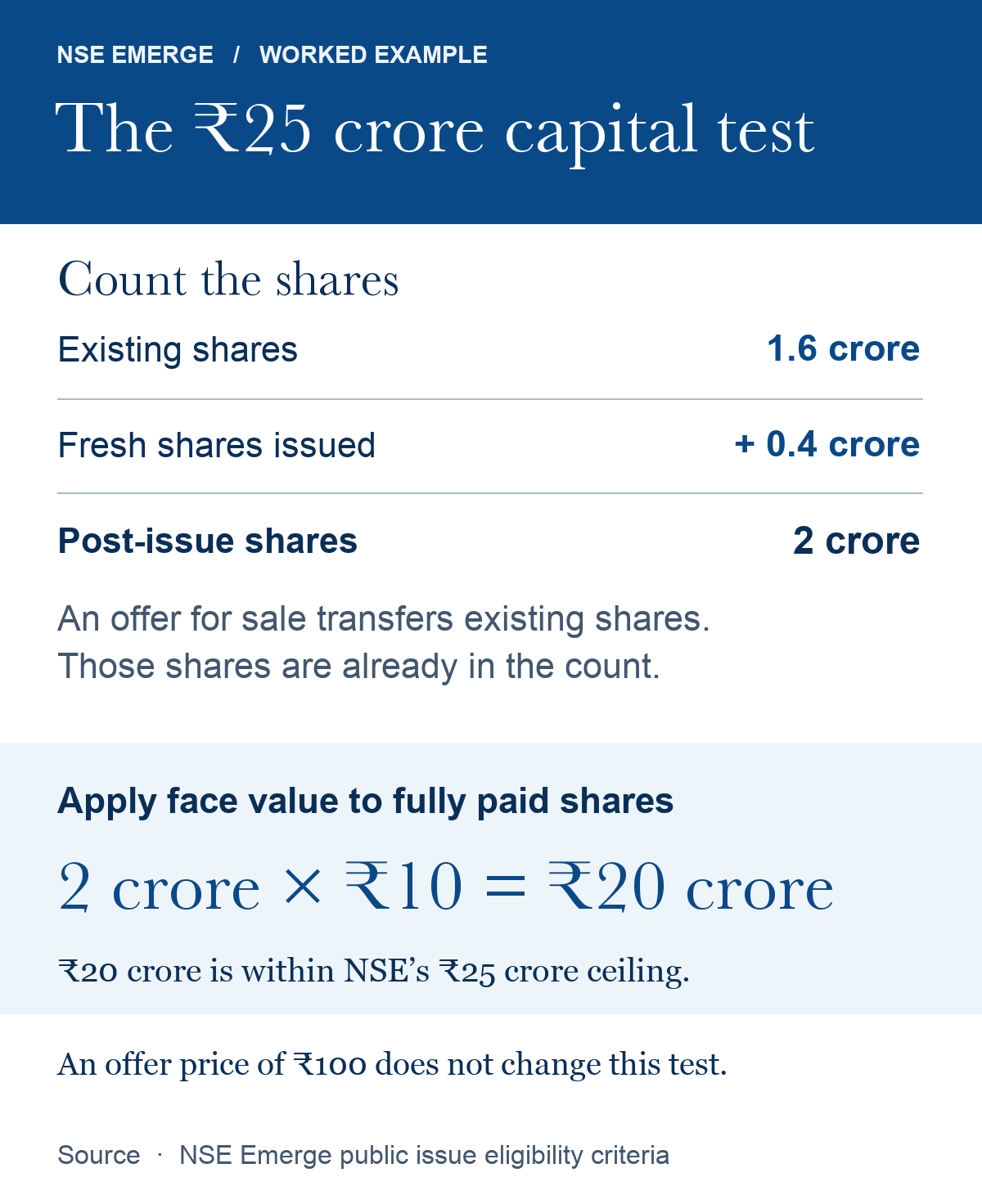
Regulation 229(1) covers post-issue paid-up capital up to ₹10 crore. Regulation 229(2) also permits Chapter IX issues above ₹10 crore and up to ₹25 crore. These thresholds measure nominal capital. For example, two crore fully paid post-issue shares of ₹10 face value represent ₹20 crore of paid-up capital, even if the offer price is ₹100 a share. The exchange publishes separate criteria for technology startups. The table above covers its standard SME route. NSE’s standard and technology startup criteria.
Whose track record counts?
Where an applicant relies on promoter experience, NSE specifies at least three years in the same line of business and a holding of at least 20% of post-issue equity by the relevant promoter or promoters. Check those holdings after modelling the fresh issue and any sell-down. If a proprietorship, firm or LLP converted into the issuer, regulation 229(4) requires at least one full financial year in corporate form before draft filing. To rely on a partnership or LLP’s operating-profit history, obtain the prescribed Schedule III financial information and certification from an auditor with a valid ICAI peer-review certificate. NSE track-record criterion · ICDR regulation 229(3)–(4).
Review the dates of changes in control and ownership. A complete change of promoter, or the acquisition of more than 50% of the issuer’s shares by new promoters, triggers a one-year wait from the final such change before the draft can be filed. The relevant dates may sit in historic transfer filings or shareholder agreements. ICDR regulation 229(5).
How to calculate FCFE for NSE Emerge
NSE’s 20 April 2026 circular revised the calculation to include qualifying cash proceeds from issuing capital. Start with net operating cash after income tax. Deduct net fixed-asset purchases, add qualifying capital receipts and net borrowings, then deduct after-tax interest on borrowings. Net fixed-asset purchases include eligible intangibles, capital work in progress and capital advances, allowing for applicable sale proceeds. NSE circular NSE/SME/73818, Annexure A.
Worked example in ₹ crore. In NSE’s illustration, operations generate 26 after tax. Net fixed-asset purchases use 19. A cash share issue brings in 1 of face capital and 3 of securities premium. Long-term borrowing of 12.4 less repayments of 7.3 and a 2.7 fall in short-term cash credit give net borrowings of 2.4. After-tax interest is 4. The result is 26 − 19 + 4 + 2.4 − 4 = 9.4. That establishes one positive year. The issuer still needs a second qualifying year. NSE’s worked example.
Use the three preceding years’ restated offer-document accounts. Use consolidated accounts where available and standalone accounts where consolidated accounts are unavailable or need not be furnished. Exclude stubs and projections. Cash equity and qualifying preference capital, including issue premium, may count. A debt conversion or shares issued for an asset generate no cash proceeds. Count short-term borrowing movements once if already included in operating cash flow. NSE gives non-banking financial companies separate instructions for borrowing and interest. NSE FCFE FAQs, questions 1–13.
Offer structure, use of proceeds and legal checks
An offer for sale (OFS) has two caps. Selling shareholders together can offer up to 20% of the total issue size, and each seller can offer up to 50% of their own pre-issue holding on a fully diluted basis. Trace where fresh proceeds will go. NSE excludes an issue that would repay a loan from a promoter, promoter-group member or related party, directly or indirectly. Check the underlying payee even when the stated object is refinancing. General corporate purposes are capped at the lower of ₹10 crore and 15% of the amount the issuer raises. ICDR regulation 230(1)(f)–(h) and (2) · NSE offer and listing conditions.
Screen the issuer and relevant parties for SEBI debarment, wilful default and fraudulent-borrower status. Check promoters and directors for fugitive economic offender status, and examine outstanding rights to receive equity. Regulation 228 provides exceptions for qualifying employee options and fully paid convertibles that must convert by the RHP or prospectus filing. Review admitted insolvency proceedings against the issuer or promoting companies, admitted winding-up petitions against the issuer, and material regulatory or disciplinary action against it in the past three years. NSE also checks whether it returned an IPO draft in the previous six months from the left lead merchant banker or another banker responsible for diligence and drafting. Obtain the bankers’ allocation of responsibilities and check NSE’s return record. ICDR regulation 228 · NSE listing and disclosure conditions.
A pre-filing checklist for promoters and advisers
- Company secretary. Reconcile the post-issue capital table, allotments, conversions and promoter changes against statutory registers, filings and signed agreements.
- CFO and reporting accountant. Tie each annual operating-profit and FCFE calculation to the restated accounts. Document capital receipts, securities premium, borrowings, tax and interest so another reviewer can reproduce each figure.
- Board and merchant banker. Test both OFS caps, document each proposed use of fresh funds and record which eligibility criteria need checking again at the RHP or prospectus stage.
- Legal counsel. Check proceedings, lending defaults, licences and promoter disclosures against independent records. Record material changes between the DRHP and final offer document. Candour Legal’s IPO and capital markets practice.
Budget for the merchant banker’s due diligence and site visit before exchange filing. The current SME framework calls for underwriting of the entire issue and market making for at least three years after listing. ICDR regulations 246, 260 and 261.
SEBI’s October 2026 paper proposes using post-issue market capitalisation to select the platform and testing a three-year average operating profit of ₹3 crore. These proposals have no effect on the eligibility calculation for a filing as of 14 November 2026. SEBI consultation, §5.1 · Candour Legal’s analysis of the proposed SME IPO reforms.
Frequently asked questions
Is ₹25 crore the largest IPO a company can raise on NSE Emerge?
The ₹25 crore ceiling applies to post-issue paid-up share capital at face value. The cash raised depends on the offer price, including premium, and the number of fresh shares. An offer for sale transfers existing shares.
Can a company with three years of profits still fail the FCFE test?
Yes. Capital expenditure, borrowing repayments and other cash movements can leave free cash flow to equity at or below zero. The standard NSE Emerge route requires positive FCFE in at least two of the three preceding financial years.
Can a recent fundraise improve a prior year’s FCFE?
Only qualifying cash proceeds received in the financial year being tested enter that year’s calculation. A non-cash debt conversion, an asset exchange, a later stub-period receipt or projected IPO proceeds cannot be added to a prior year.
When does an issuer have to meet the eligibility criteria?
NSE checks eligibility at the draft filing for in-principle approval and again at the red herring prospectus and prospectus stages, as applicable. Refresh the financial tests if the reporting years change and recheck the capital and offer structure against the latest terms.


Speak to a senior advocate about your matter.
Tell us what's going on. We review every enquiry personally and reply within 24 working hours.
Schedule a Consultation
Takes under a minute. We'll come back to you within 24 working hours.
Request received.
Thank you — a Candour Legal advocate will contact you within 24 working hours.
Urgent? Call us right away.
Disclaimer — Bar Council of India
As per the rules of the Bar Council of India, advocates and law firms are not permitted to solicit work or advertise. This website is intended solely to provide general information about Candour Legal and its areas of practice, and is made available to the user only at the user's own specific request. The contents of this website do not constitute, and should not be construed as, legal advice, an advertisement, a solicitation or an invitation of any kind. Candour Legal assumes no liability for any action taken in reliance on the material on this website; readers facing a legal issue should seek appropriate professional advice on their specific circumstances. Use of this website, or transmission of any enquiry through it, does not create a lawyer-client relationship between the user and Candour Legal.
BEFORE YOU GO
Get a free 15-minute case assessment
Tell us what's going on and a Candour Legal advocate will call you back — no charge, no obligation.
Schedule my free assessment Call now