


By Candour Legal Team · Legal position reviewed on 16 November 2026
An investor applying for a book-built SME IPO on NSE Emerge can change categories by adding just one lot. The SME IPO minimum application size is two lots, with a value above ₹2 lakh. In the public offer, an individual who bids for exactly two lots uses the Individual Investor category. At three or more lots the same person bids as a non-institutional investor (NII). The category determines which pool of shares is available when the issuer makes allotments. SEBI ICDR regulation 267 · NSE e-IPO FAQs, questions 9–10.
Compare the two-, three-, eight- and nine-lot bids
Calculate the SME IPO minimum application size
Find the number of shares in one lot in the issue’s red herring prospectus (RHP) and price-band announcement. Multiply the number of lots by the shares per lot and the price per share you plan to bid. Use the bid price shown in rupees, including any premium over face value. Regulation 267 measures the minimum application value at the issue price. ₹2 lakh exactly does not cross the statutory threshold, and the issuer invites bids in whole-lot increments. ICDR regulation 267(2)–(4) · SEBI circular on standardised SME lot sizes.
Choose an explicit price within the advertised band. On NSE, no SME applicant can tick a cut-off price option, reduce the bid or cancel it. Bidding at the cap means entering the upper price yourself. If you bid below the final issue price, your bid cannot receive shares. Check quantity and price before sending the instruction. NSE’s SME bidding circular · NSE-hosted basis of allotment showing price eligibility.
Find the SME offer documents on NSE
Four bids for the same offer at ₹125 a share
Assume a book-built offer has a lot of 1,000 shares. Four individuals bid in the public offer at ₹125 a share, which is also the final issue price. One lot is worth ₹1.25 lakh. The figures below are illustrative and exclude employee and other reserved applications.
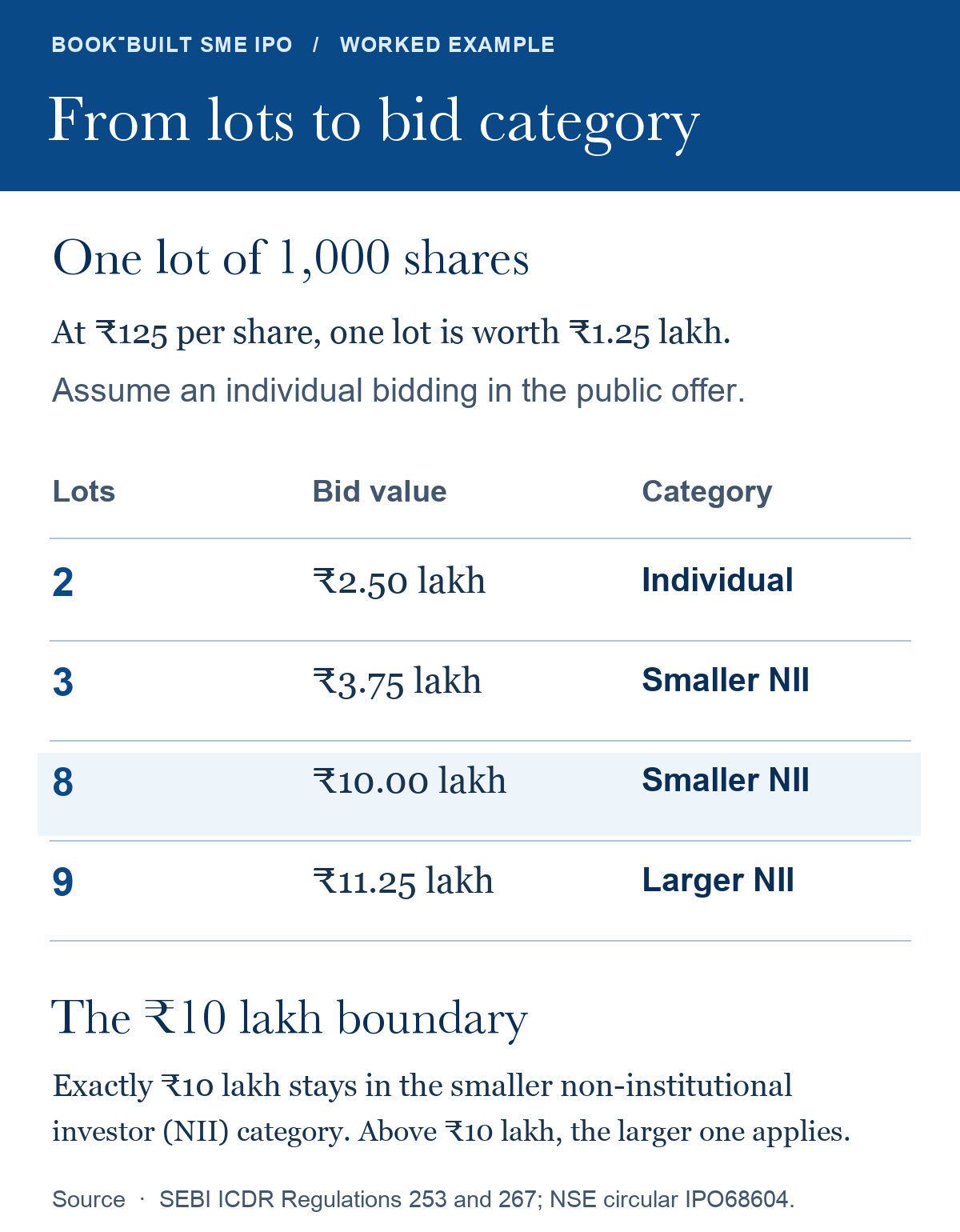
- Asha bids for two lots. Her 2,000 shares cost ₹2.50 lakh. She qualifies for the Individual Investor category even though the value exceeds ₹2 lakh.
- Dev bids for three lots. His 3,000 shares cost ₹3.75 lakh. He enters the NII subcategory for bids above two lots and up to ₹10 lakh.
- Meera bids for eight lots. Her 8,000 shares cost precisely ₹10 lakh. That amount is included in the lower NII band.
- Ravi bids for nine lots. His 9,000 shares cost ₹11.25 lakh. His entire application enters the higher NII band.
In another offer, the first bid above ₹10 lakh may be a different number of lots. Divide ₹10 lakh by the value of one lot at the relevant price. The largest whole number within that limit gives the last lot count in the lower NII band, provided it exceeds two lots. ICDR regulation 253(2).
How the category affects actual allotment
In a book-built SME IPO, at least 35% of the net offer goes to individuals applying for the minimum and at least 15% to NIIs. Qualified institutional buyers can receive up to 50%. Within the NII portion, one-third is reserved for the lower band and two-thirds for the higher band. An unused balance in one NII band may pass to the other. These percentages concern shares available across categories. They do not assign a probability of success to an applicant. ICDR regulation 253(1)–(2).
For NII allotment, the issue team first considers how many applicants can receive the minimum NII quantity from the shares available. Where shares remain after the minimum allotments, the balance is allocated proportionately. When there are too few minimum blocks, SEBI’s illustration shows successful applicants selected by draw. The final basis of allotment, prepared with the designated exchange, shows which quantities were actually allotted. ICDR regulation 268(3A)–(4) · Schedule XIV, Part A2, Example B.
Qualiance International’s NSE Emerge IPO shows the difference. At the final price of ₹127, its September 2026 allotment notice recorded 2,60,741 eligible individual applications for 2,000 shares each after rejections. Only 591 applicants received shares in that category. In the higher NII band, two of the 671 applicants bidding for 9,000 shares received 3,000 shares each. Applicants can look up their own result with the issue registrar named in the prospectus. Qualiance International’s basis of allotment, sections 1 and 3.
What to check before the issue closes
For an NSE SME IPO, the last-day bidding window closes at 4 p.m. and UPI mandate confirmation, where applicable, closes at 5 p.m. Both times are Indian Standard Time. Confirm your intermediary’s submission deadline and payment route before authorising the block. Keep the application number and check that the quantity and bid price recorded match your instructions. A successful funds block confirms a payment step. Use the registrar’s allotment result to find the number of shares you received. NSE circular of 18 June 2025 · NSE e-IPO FAQs.
For an issuer preparing its documents, check that the RHP, price-band advertisement and bid instructions use the same lot size, category boundaries and payment timetable. Where the issue includes a reservation for eligible employees or shareholders, set out that route separately. The public bid examples above concern the net offer. Candour Legal’s guide to reading an SME IPO draft prospectus.
What SEBI proposed in October 2026
SEBI’s 14 October consultation proposed a four-lot minimum, with a minimum value of ₹25,000 for each lot and a ₹1 lakh minimum application value. It also proposed bringing back the Retail Individual Investor category. Those proposals had not taken effect as of 16 November 2026. The current two-lot rule and NSE’s bidding instructions still govern the example here. SEBI consultation, section 5.5.1.6 · Candour Legal’s consultation analysis.
Discuss the bid categories in an SME IPO draft prospectus
Frequently asked questions
Can I apply for one lot if I can afford more than ₹2 lakh?
No. The minimum SME IPO application is two lots and its value must exceed ₹2 lakh. Use the shares per lot and price in the documents for the specific offer.
If two lots cost ₹2.50 lakh, am I already an NII?
An individual applying for exactly two lots in the public offer is in the Individual Investor category. On NSE, the same person bidding for three or more lots is classified as NII – Individual.
Which NII band covers a bid worth exactly ₹10 lakh?
An eligible NII bid worth exactly ₹10 lakh falls in the lower subcategory. Only a bid worth more than ₹10 lakh enters the higher subcategory, and the whole bid goes into that band.
Can a valid NII application receive fewer shares than requested?
Yes. Allotment depends on the shares available and the final basis of allotment. A successful NII applicant can receive fewer shares than requested, while an unsuccessful applicant can receive none.
Speak to a senior advocate about your matter.
Tell us what's going on. We review every enquiry personally and reply within 24 working hours.
Schedule a Consultation
Takes under a minute. We'll come back to you within 24 working hours.
Request received.
Thank you — a Candour Legal advocate will contact you within 24 working hours.
Urgent? Call us right away.
Disclaimer — Bar Council of India
As per the rules of the Bar Council of India, advocates and law firms are not permitted to solicit work or advertise. This website is intended solely to provide general information about Candour Legal and its areas of practice, and is made available to the user only at the user's own specific request. The contents of this website do not constitute, and should not be construed as, legal advice, an advertisement, a solicitation or an invitation of any kind. Candour Legal assumes no liability for any action taken in reliance on the material on this website; readers facing a legal issue should seek appropriate professional advice on their specific circumstances. Use of this website, or transmission of any enquiry through it, does not create a lawyer-client relationship between the user and Candour Legal.
BEFORE YOU GO
Get a free 15-minute case assessment
Tell us what's going on and a Candour Legal advocate will call you back — no charge, no obligation.
Schedule my free assessment Call now