Candour Legal – Best Lawyers in Ahmedabad | Law firm in Ahmedabad





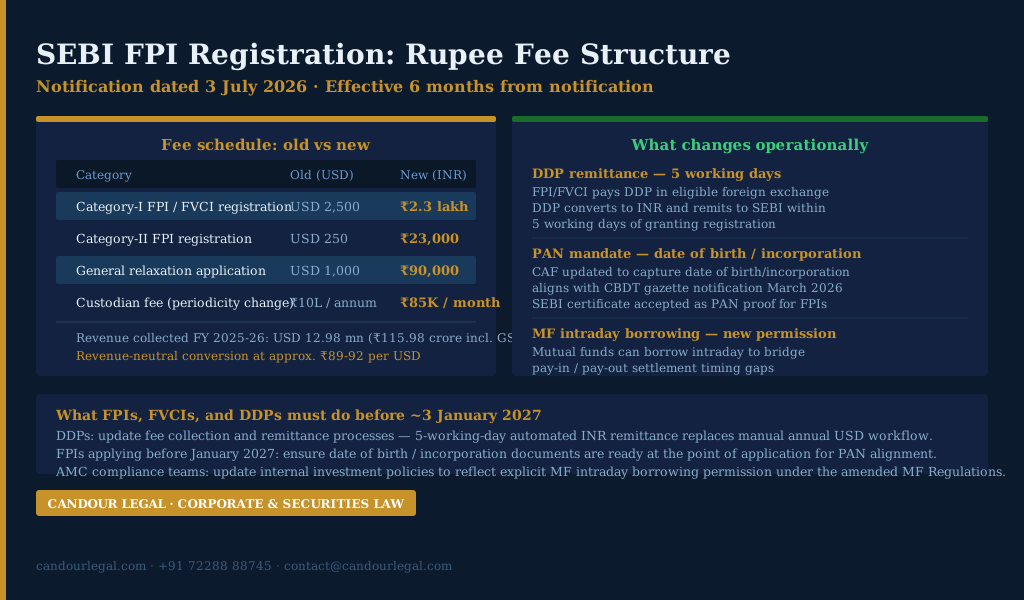

SEBI collected approximately USD 12.98 million — roughly ₹115.98 crore including GST — in FY 2025–26 from FPI and FVCI registration, continuation, and related fees. Every rupee of that came in as dollars, was manually accounted for, took days to reconcile across departments, and created cash-flow mismatches because custodians paying on the first five days of each month left any fee falling due later that month on SEBI’s books for another four weeks. The July 2026 amendment to the SEBI (Foreign Portfolio Investors) Regulations, 2019 ends that operational friction and, in doing so, makes a structural statement: SEBI’s administrative infrastructure is being recalibrated for a market where FPI flows are denominated in dollars but regulated in rupees.
Key Takeaways
- SEBI’s notification dated 3 July 2026 amends the SEBI (FPI) Regulations, 2019, replacing USD-denominated fees with INR equivalents across all categories. Changes take effect six months from notification — approximately January 2027.
- Category-I FPI and FVCI registration fee: USD 2,500 → ₹2.3 lakh. Category-II registration fee: USD 250 → ₹23,000. General relaxation application fee: USD 1,000 → ₹90,000 in eligible foreign exchange equivalent.
- Late fee and continuance fee also revised in the same notification. SEBI collected ₹115.98 crore in FPI and FVCI fees in FY 2025–26.
- Designated Depository Participants must remit collected fees to SEBI in INR within five working days of the grant of registration. FPIs and FVCIs pay the DDP in eligible foreign exchange; the DDP converts and remits.
- Custodian fees revised from annual (₹10 lakh per annum) to monthly (₹85,000 per month), improving real-time cash flow visibility for SEBI.
- Common application form updated to capture the applicant’s date of birth or date of incorporation, aligning with the CBDT gazette notification of March 2026 on PAN application requirements for foreign entities.
- Companion amendment to SEBI (Mutual Funds) Regulations permits intraday borrowing for settlement mismatch management — addressing pay-in/pay-out timing differences across asset classes, forex, and other transactions. This is in addition to the existing 20% net asset borrowing limit for redemptions.
The Fee Structure: Old, New, and the Revenue Neutrality Calculation
Regulation 43B of the SEBI (FPI) Regulations, 2019 governs the fee schedule applicable to FPIs and FVCIs. Prior to the amendment, the regulation specified fees in USD — a legacy of the framework’s origin in an era when FPI flows were entirely foreign-currency-denominated and SEBI’s administrative infrastructure was calibrated accordingly. The July 2026 amendment substitutes the USD figures with INR equivalents throughout the regulation.
The conversion was calibrated for revenue neutrality. SEBI received ₹115.98 crore in FPI and FVCI fees in FY 2025–26 against a USD intake of $12.98 million, implying an effective exchange rate of approximately ₹89.36 per USD at the time of the board’s revenue-neutrality calculation. The ₹2.3 lakh equivalent for the Category-I fee (replacing USD 2,500) represents an exchange rate of ₹92 per USD, marginally above the neutrality rate — a modest buffer for exchange rate movement. The Category-II equivalent of ₹23,000 (replacing USD 250) implies the same rate. The ₹90,000 general relaxation fee replacing USD 1,000 implies ₹90 per USD, slightly below the neutrality rate but within a commercially reasonable range.
FPIs and FVCIs will continue to pay in eligible foreign exchange — the amendment does not require them to hold rupee accounts for fee payment purposes. They pay the DDP in USD (or other eligible currencies) at an amount equivalent to the prescribed INR fee at the prevailing rate. The DDP converts and remits in INR to SEBI within five working days. The currency conversion risk and administrative cost of conversion fall on the DDP rather than on SEBI — a clean operational shift that resolves SEBI’s manual reconciliation problem while maintaining the foreign-currency-denominated nature of the transaction for the FPI.
The DDP’s New Obligations: Five-Day Remittance and Monthly Custodian Payments
Designated Depository Participants occupy a structurally important position in the FPI registration and operational chain. Every FPI that wishes to invest in Indian securities must appoint a DDP — a SEBI-registered entity (typically a bank or its subsidiary) that acts as the FPI’s interface with SEBI, Indian exchanges, and depositories. The DDP is responsible for on-boarding the FPI, verifying eligibility, and maintaining ongoing compliance. The amendment adds a remittance obligation to this role: the DDP must now remit registration fees collected from the FPI in INR to SEBI within five working days of the grant of registration, along with prescribed details in the specified format.
The five-day window is tight by Indian financial services standards. DDPs receiving a registration fee in USD from a newly onboarded FPI will need to execute the forex conversion and the SEBI remittance within five working days of the registration grant date. For large DDPs processing multiple registrations simultaneously, this requires a standardised internal process — not a manual workflow. The earlier system, under which custodians paid fees annually in the first five days of a month, created timing mismatches whenever a registration was granted between the sixth and last day of a month. The monthly custodian fee cycle (₹85,000 per month replacing ₹10 lakh per annum) is revenue-neutral but changes the cash-flow cadence: SEBI now receives custodian fees monthly rather than annually, improving SEBI’s working capital position and reducing its exposure to the credit risk of large annual custodian payments.
The PAN Mandate: Why Date of Birth and Incorporation Now Matter at Registration
The CBDT gazette notification of March 2026 revised PAN application forms for foreign citizens and foreign entities. Under the revised forms, applicants must submit apostilled proof of date of birth (for individuals) or date of incorporation (for entities) when applying for a PAN. For FPIs applying for PAN as part of the onboarding process — a mandatory step since PAN is required for trading in Indian securities — this created a gap: SEBI’s registration certificate did not contain the date of birth or incorporation, so it could not be used as sole proof for PAN application purposes. The FPI needed to submit a separate certified document.
The amendment to the common application form bridges that gap. By capturing the date of birth or date of incorporation in the CAF at the point of FPI registration, SEBI ensures that its registration certificate contains all the information required for PAN application under the CBDT’s revised framework. The registration certificate — already accepted as proof of identity and address for FPIs — can then serve as proof of date of birth or incorporation as well, eliminating the need for a separate apostilled document in the PAN application. For foreign entities onboarding to Indian markets, the administrative burden of PAN procurement is materially reduced.
The Mutual Fund Intraday Borrowing Change
Buried in the same notification is an amendment to the SEBI (Mutual Funds) Regulations, 1996 that carries practical significance for AMCs and their compliance functions. The existing framework permits mutual fund schemes to borrow up to 20% of net assets for meeting unitholder redemptions and other specified obligations. The July 2026 amendment adds a new category of permitted borrowing: intraday borrowing to bridge differences arising from pay-in and pay-out settlement timings within asset classes, forex settlements, and other transactions.
The problem the amendment addresses is structural. Indian securities settlement operates on T+1 for equities and has varying settlement cycles for debt instruments, exchange-traded derivatives, and forex transactions. A fund that sells equities on a given day to meet redemptions may have the pay-in obligation due before the pay-out from the sale is credited. Similarly, a fund managing multiple asset classes with different settlement windows can have timing mismatches that require it to either keep excess liquidity as a buffer (reducing returns) or liquidate positions at suboptimal prices (increasing transaction cost). Intraday borrowing — short-term credit from the fund’s banker or custodian, typically at overnight or call money rates, repaid on the same day — resolves the timing mismatch without requiring portfolio liquidation. The amendment formalises this practice, which has been common informally but lacked explicit regulatory sanction.
What FPIs, FVCIs, DDPs, and Custodians Must Do Before January 2027
The six-month transition window runs from 3 July 2026 to approximately 3 January 2027. Three workstreams are time-sensitive. First, DDPs must update their fee collection and remittance processes — the manual USD-to-INR workflow used for the annual custodian payment cycle must be replaced with a five-working-day automated remittance process for registration fees and a monthly payment cycle for custodian fees. Technology and treasury teams at DDP entities need to be involved immediately. Second, the common application form update affects every FPI and FVCI onboarding from the notification date — entities applying for registration before January 2027 should ensure their date of birth or date of incorporation documents are ready at the time of application. Third, AMC compliance and treasury teams handling intraday borrowing should note that the amended SEBI (Mutual Funds) Regulations now expressly sanction the practice — internal investment policies and borrowing authority frameworks should be updated to reflect the new explicit permission.
Looking Ahead
The shift from dollar to rupee fee denomination is one element of a broader SEBI posture of internalising foreign investor administration within the Indian rupee ecosystem. It sits alongside the rupee trade settlement initiative for select bilateral trade corridors, the rupee-denominated FPI investment limit frameworks, and the ongoing push to deepen the rupee bond market. For FPIs and FVCIs, the practical impact of the January 2027 transition is modest — they continue to pay in eligible foreign exchange, the DDP absorbs the conversion — but the regulatory direction is clear: as India’s capital markets deepen, administrative infrastructure will be standardised in rupees regardless of the currency of the underlying investment.
Frequently Asked Questions
What is the SEBI FPI registration fee after the July 2026 amendment?
Category-I FPI and FVCI registration fee: ₹2.3 lakh (previously USD 2,500). Category-II: ₹23,000 (previously USD 250). General relaxation application fee: ₹90,000 in eligible foreign exchange equivalent (previously USD 1,000). Changes take effect six months from 3 July 2026.
When do the SEBI FPI rupee fee changes take effect?
Six months from the notification date of 3 July 2026 — approximately 3 January 2027. FPIs, FVCIs, DDPs, and custodians have until then to update their payment systems and processes.
What are Designated Depository Participants required to do under the new rules?
DDPs must collect registration fees from FPIs and FVCIs in eligible foreign exchange equivalent to the prescribed INR amount, convert to INR, and remit to SEBI within five working days of the grant of registration. Custodian fee payments shift from annual (₹10 lakh per annum) to monthly (₹85,000 per month).
Why is SEBI shifting FPI fees from USD to rupees?
To address three operational problems: manual accounting and reconciliation for USD receipts lacking real-time visibility; significant man-hours spent on reconciliation across SEBI departments; and the timing mismatch created by custodians paying only in the first five days of each month, leaving fees due later in the month unrecovered until the following month.
What is the mutual fund intraday borrowing change?
SEBI has amended the SEBI (Mutual Funds) Regulations, 1996 to explicitly permit intraday borrowing by mutual fund schemes to bridge pay-in/pay-out settlement timing differences across asset classes, forex, and other transactions. This supplements the existing 20% net asset borrowing limit for redemptions and formalises a practice that has been common informally.
What is the PAN date-of-birth mandate for FPIs?
SEBI has updated the common application form to include the applicant’s date of birth or date of incorporation, aligning with CBDT’s March 2026 gazette notification requiring these details for PAN applications by foreign citizens and entities. Once included in the SEBI registration certificate, these details eliminate the need for a separate apostilled proof document in the PAN application process.
Speak to Candour Legal’s Capital Markets team
Candour Legal advises foreign portfolio investors, foreign venture capital investors, designated depository participants, asset management companies, and market intermediaries on SEBI regulatory compliance, FPI registration and onboarding, and securities law matters.
About the author
Manasvi Thapar, Founding Advocate at Candour Legal, advises foreign portfolio investors, market intermediaries, and financial institutions on SEBI regulatory compliance, securities law, and capital markets transactions.
Candour Legal is a full-service Indian law firm with offices in Ahmedabad, Mumbai, and New Delhi. More on our practice areas.
Further reading


Speak to a senior advocate about your matter.
Tell us what's going on. We review every enquiry personally and reply within 24 working hours.
Schedule a Consultation
Takes under a minute. We'll come back to you within 24 working hours.
Request received.
Thank you — a Candour Legal advocate will contact you within 24 working hours.
Urgent? Call us right away.
Disclaimer — Bar Council of India
As per the rules of the Bar Council of India, advocates and law firms are not permitted to solicit work or advertise. This website is intended solely to provide general information about Candour Legal and its areas of practice, and is made available to the user only at the user's own specific request. The contents of this website do not constitute, and should not be construed as, legal advice, an advertisement, a solicitation or an invitation of any kind. Candour Legal assumes no liability for any action taken in reliance on the material on this website; readers facing a legal issue should seek appropriate professional advice on their specific circumstances. Use of this website, or transmission of any enquiry through it, does not create a lawyer-client relationship between the user and Candour Legal.
BEFORE YOU GO
Get a free 15-minute case assessment
Tell us what's going on and a Candour Legal advocate will call you back — no charge, no obligation.
Schedule my free assessment Call now