


By Candour Legal Team · Legal position reviewed on 14 November 2026
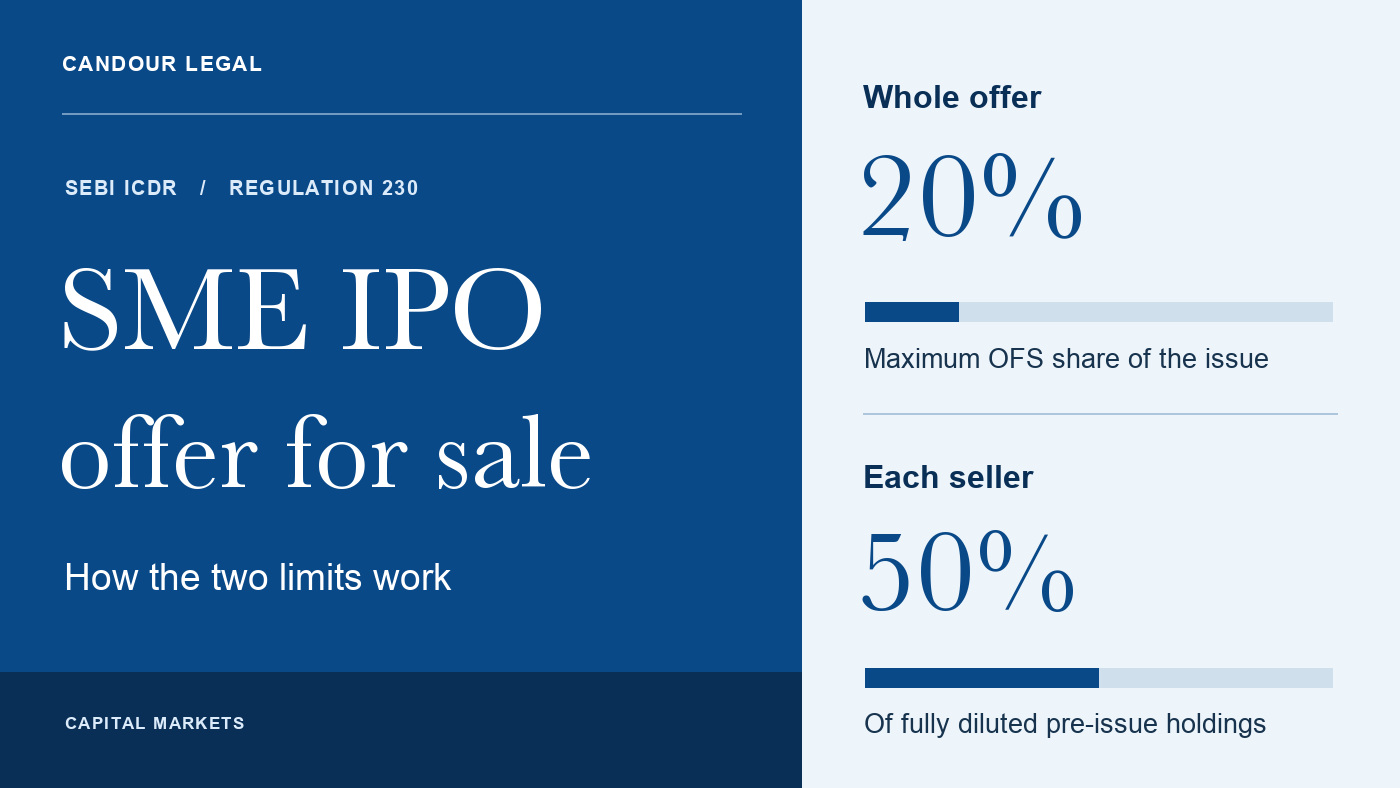
An offer for sale (OFS) lets existing shareholders sell shares in an SME IPO. The company receives the proceeds of the fresh issue. The selling shareholders receive the proceeds of their sale. SEBI’s SME IPO offer for sale limits require two calculations: all sellers together may account for up to 20% of the total issue, and each seller may offer up to 50% of its own fully diluted pre-issue holding. A sale can satisfy the first limit and still fail the second. SEBI ICDR Regulations, regulation 230(1)(f)–(g).
Step 1. Size the combined sale against the whole issue
Add the fresh shares to the shares all existing holders want to sell. At one common offer price, the combined sale quantity divided by that total must be no more than 20%. If management has already fixed the number of fresh shares, a shortcut is to divide the fresh quantity by four. An issue of 8 lakh fresh shares therefore has room for up to 2 lakh OFS shares. The total offer would be 10 lakh shares. ICDR regulation 230(1)(f).
This distinction matters when the board discusses a fundraising target. An IPO of ₹10 crore consisting of ₹8 crore of fresh shares and ₹2 crore of OFS brings the company ₹8 crore before issue expenses. Only the fresh shares increase its issued share count. Record the company’s funding need and each shareholder’s desired exit separately before allocating the offer.
Step 2. Test each seller against its own holding
For each proposed seller, start with its own pre-issue shareholding on a fully diluted basis. Multiply that holding by 50%, then compare the result with the quantity it proposes to sell. Have the company secretary and merchant banker reconcile outstanding convertible instruments, their terms and the actual shares available for delivery. A diluted holding used to measure the ceiling does not itself make an unissued or locked-in share available to sell. ICDR regulation 230(1)(g).
Worked example: the offer fits, but one seller exceeds its cap
Assume one common price, 8 lakh fresh shares and 2 lakh existing shares offered for sale. Seller A has a fully diluted pre-issue holding of 1.2 lakh shares and wants to sell 70,000. Seller B holds 4 lakh and wants to sell 1.3 lakh. Assume their shares are otherwise eligible. The aggregate is exactly 20% of the offer, but A’s individual ceiling is 60,000. B’s ceiling is 2 lakh.
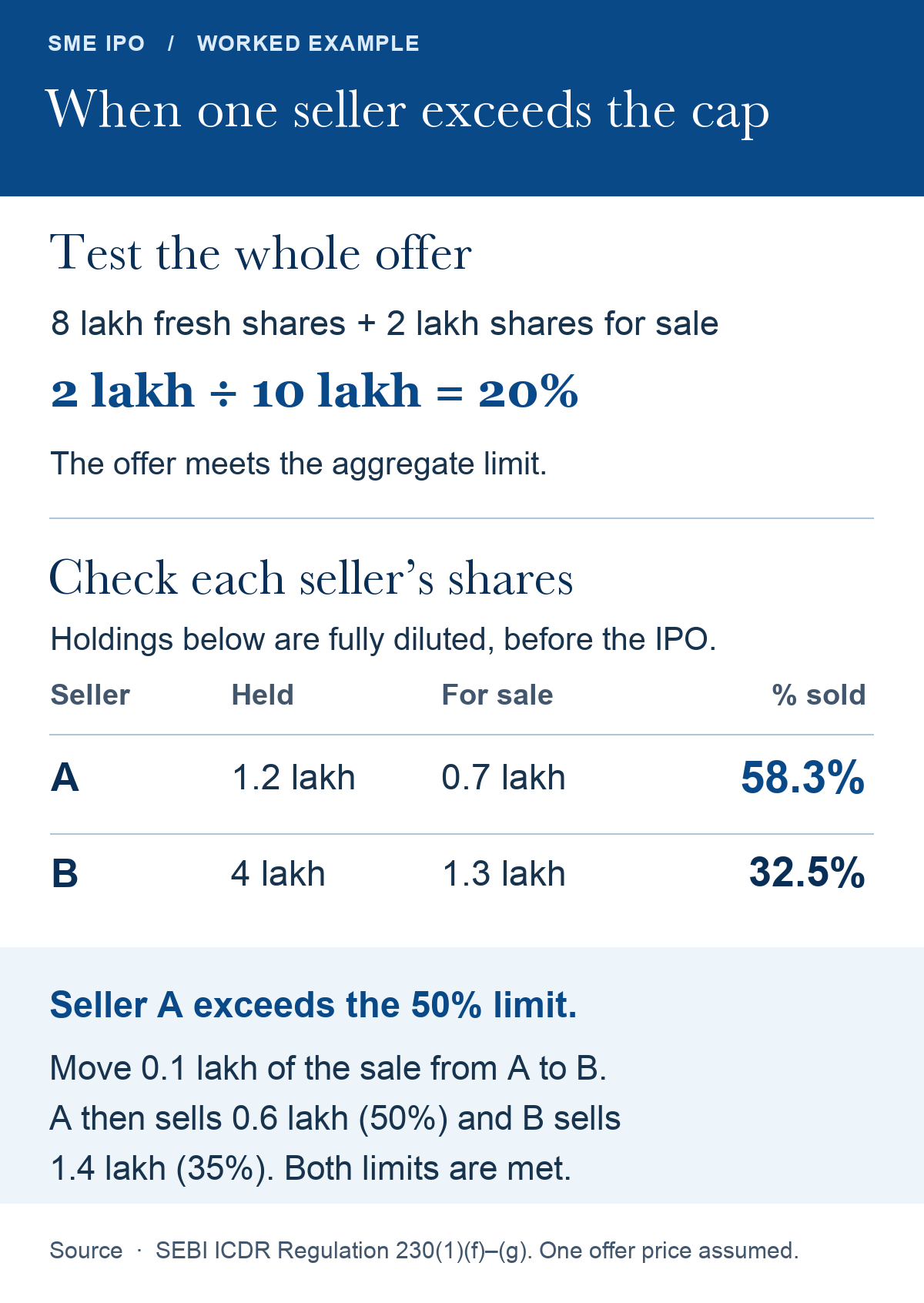
If B agrees, A could offer 60,000 and B could offer 1.4 lakh. The revised 2 lakh-share OFS satisfies both numerical tests. If B prefers its original quantity, A can cut its sale and the overall offer can shrink. Recalculate the percentage using the revised offer size. A shareholder’s willingness to sell is a commercial decision as well as a ceiling in the calculation.
What to verify before the draft offer document
- Fix the inputs. Date the capital table, identify the legal and beneficial holders, and reconcile depository records, share allotments and conversions. Keep a separate proposed quantity and cap for each seller.
- Check title and availability. Review pledges, lender consents, shareholder agreements and any transfer restrictions. Confirm selling shareholders’ securities are in dematerialised form before draft filing. For a promoter sale, reconcile the remaining holding with applicable minimum contribution and lock-in requirements. ICDR regulation 230(1)(d) · ICDR regulations 236–239.
- Follow the proceeds. Make the cover, capital structure, objects of the issue and seller disclosures agree on who receives which amount. Match seller authorisations and the offer agreement to the final quantities.
- Rerun both caps when terms change. A reduced fresh issue or a seller withdrawal changes the calculation. Retain the dated working and check the chosen exchange’s requirements at the later filing. NSE Emerge admission criteria.
Open the NSE Emerge readiness checklist
What the October 2026 consultation would change
SEBI’s 14 October paper proposes a dedicated regulation 230A. It would generally introduce a one-year holding period before draft filing, with specified exceptions. It would exempt qualified institutional buyers (QIBs) from both numerical caps except for IPOs using the proposed alternative route under regulation 229(7). The draft would also count secondary sales between draft filing and issue opening towards the limits. SEBI describes current Chapter IX as having no general one-year OFS holding-period requirement. Specific transfer restrictions still need checking, and the proposed QIB relief was not in force on 14 November 2026. SEBI consultation, §5.3 · Candour Legal’s analysis of the consultation.
Frequently asked questions
If the fresh issue shrinks, can sellers keep the same OFS?
Recalculate the issue-wide ceiling. At one price, a fresh issue of 6 lakh shares supports up to 1.5 lakh OFS shares. Keeping a 2 lakh OFS would put sellers at 25% of the resulting 8 lakh-share offer. Each seller must also pass the individual test.
Can a promoter use an investor’s unused 50% allowance?
Each seller’s limit belongs to that shareholder. Another investor may increase its own sale if it has eligible shares, agrees to the revised quantity and stays within its own cap. The combined OFS must still fit the issue-wide ceiling.
Does a qualified institutional buyer have a larger exit allowance today?
As of 14 November 2026, the SME rules apply both caps to selling shareholders, including QIBs. SEBI’s October consultation proposes a conditional exemption. An issuer preparing its offer should use the rules in force on the relevant filing date.


Speak to a senior advocate about your matter.
Tell us what's going on. We review every enquiry personally and reply within 24 working hours.
Schedule a Consultation
Takes under a minute. We'll come back to you within 24 working hours.
Request received.
Thank you — a Candour Legal advocate will contact you within 24 working hours.
Urgent? Call us right away.
Disclaimer — Bar Council of India
As per the rules of the Bar Council of India, advocates and law firms are not permitted to solicit work or advertise. This website is intended solely to provide general information about Candour Legal and its areas of practice, and is made available to the user only at the user's own specific request. The contents of this website do not constitute, and should not be construed as, legal advice, an advertisement, a solicitation or an invitation of any kind. Candour Legal assumes no liability for any action taken in reliance on the material on this website; readers facing a legal issue should seek appropriate professional advice on their specific circumstances. Use of this website, or transmission of any enquiry through it, does not create a lawyer-client relationship between the user and Candour Legal.
BEFORE YOU GO
Get a free 15-minute case assessment
Tell us what's going on and a Candour Legal advocate will call you back — no charge, no obligation.
Schedule my free assessment Call now