Candour Legal – Best Lawyers in Ahmedabad | Law firm in Ahmedabad





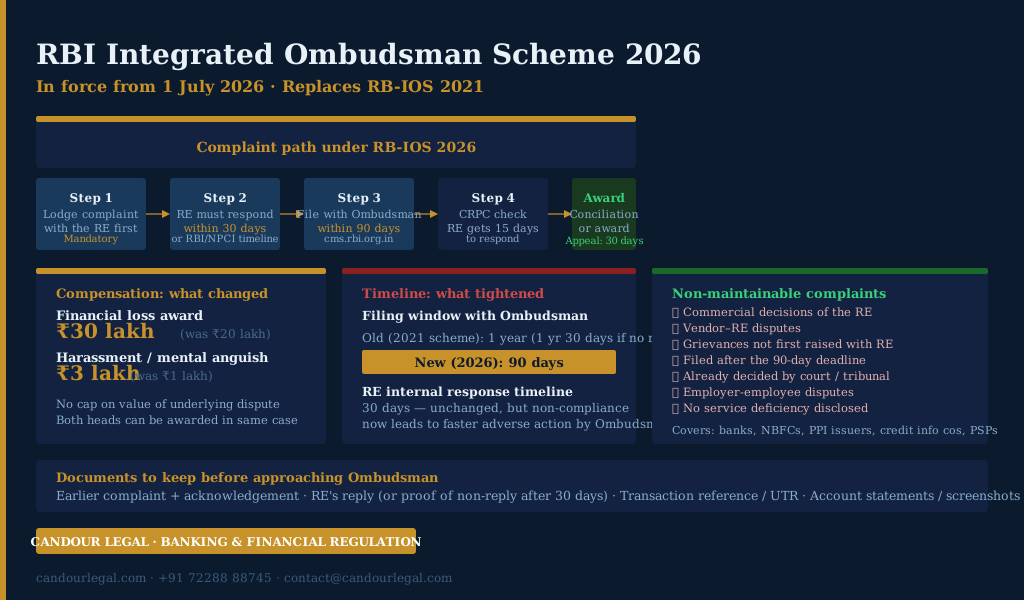

The Reserve Bank of India has operated an integrated ombudsman framework since 2021, when it merged three earlier scheme-specific ombudsmen — for banks, NBFCs, and digital payments — into a single mechanism. The 2026 scheme that came into effect on 1 July is not a structural overhaul of that 2021 architecture. It is a recalibration: tighter timelines, higher compensation, broader Deputy Ombudsman authority, and greater procedural clarity. The intent, as the RBI has stated, is to make the grievance redressal process more time-bound, efficient, and accountable. The practical effect for customers of India’s banks, NBFCs, prepaid payment instrument issuers, and credit information companies is a mechanism that is faster to navigate and more rewarding when it produces an award — provided the customer understands what the scheme covers, what it excludes, and how the timeline now works.
Key Takeaways
- The RB-IOS, 2026 came into force on 1 July 2026, replacing RB-IOS, 2021. Complaints filed under the 2021 scheme before 1 July 2026 remain governed by the earlier framework. New complaints from 1 July 2026 fall under the 2026 scheme.
- Compensation ceiling for consequential financial loss: ₹30 lakh (up from ₹20 lakh under the 2021 scheme). Compensation for loss of time, expenses, harassment, and mental anguish: ₹3 lakh (up from ₹1 lakh). No cap on the value of the underlying dispute.
- Filing deadline: 90 days from the date on which the regulated entity’s response timeline expires or from the date of the last communication from the regulated entity, whichever is later. Under the 2021 scheme, the window was one year (or one year and 30 days where no reply was received).
- A customer must first exhaust the internal grievance mechanism of the regulated entity. The entity has 30 days to respond (or the timeline prescribed by RBI, NPCI, or card network rules). Only after the response window lapses or the response is unsatisfactory can the customer approach the Ombudsman.
- Deputy Ombudsmen now have expanded powers: to examine complaints, reject non-maintainable ones, facilitate settlements, and close complaints falling under specified provisions. This should reduce the docket load on the principal Ombudsman and accelerate resolution.
- The complaint management system (CMS) portal at cms.rbi.org.in is the centralised filing channel. The Centralised Receipt and Processing Centre (CRPC) conducts the preliminary maintainability check before forwarding the complaint to the regulated entity.
- The appeal mechanism: an award passed by the Ombudsman can be appealed before the Appellate Authority within 30 days of receiving the award. The 30-day window can be condoned by up to a further 30 days if sufficient cause is shown.
Before the Ombudsman: The Internal Grievance Requirement
The 2026 scheme, like its predecessor, is not a first-resort mechanism. A customer cannot approach the RBI Ombudsman without first lodging a complaint with the concerned regulated entity through its internal grievance redressal process. The entity then has 30 days — or the timeline prescribed by the RBI, the National Payments Corporation of India, or the relevant card network — to respond. If it does not respond within that period, or if the response is unsatisfactory, the customer can escalate to the Ombudsman within 90 days.
The 30-day response obligation on regulated entities is unchanged from 2021. What has changed is the consequence of non-response: under the 2026 scheme, the Ombudsman may decide the case based on available records if the regulated entity does not respond within the stipulated time, without waiting further. The 2021 scheme gave regulated entities more room to engage before adverse action was taken. The 2026 scheme moves the balance toward the customer.
The 90-day filing window is the most significant procedural change. Under the 2021 scheme, customers had one year — and one year and 30 days where no reply was received — to approach the Ombudsman. The compression to 90 days was contested during the scheme’s drafting: consumer advocates argued that customers of rural banks and cooperative banks, who may not be digitally literate, need more time to identify the escalation mechanism and prepare a complaint. The RBI proceeded with the shorter window on the basis that the centralised CMS portal and the expanded CRPC infrastructure would make the escalation process faster and more accessible. Whether that assumption holds in practice will be evident in the complaint volume data over the next two to three quarters.
What the Scheme Covers and What It Excludes
The RB-IOS, 2026 applies to scheduled commercial banks, regional rural banks, state and central cooperative banks, urban cooperative banks meeting the prescribed deposit threshold, eligible NBFCs, non-bank prepaid payment instrument issuers, credit information companies, and other regulated payment system participants. The scheme covers deficiencies in service by these entities.
Clause 10 of the 2026 scheme lists non-maintainable complaints. The categories are substantially the same as under the 2021 scheme: complaints relating to commercial decisions of the regulated entity (such as interest rate pricing or credit limit decisions) are outside the Ombudsman’s jurisdiction; disputes between a vendor and the regulated entity are excluded; grievances not first raised with the regulated entity are not maintainable; complaints filed after the 90-day deadline are excluded; and matters already pending before or decided by a court, tribunal, or arbitrator fall outside the scheme. Employer-employee disputes and complaints that do not disclose any deficiency in service are also excluded.
The commercial decision exclusion is the most commonly misunderstood boundary. A bank’s decision to decline a loan application, to price a product at a given rate, or to set a credit limit at a given level is a commercial decision — not a service deficiency. The Ombudsman cannot override a lending or pricing decision. The Ombudsman can, however, address deficiencies in how that decision was communicated, documented, or implemented — if the bank failed to provide a written reason for a rejection that regulations require, or if the loan was disbursed with terms different from those disclosed, those are service deficiencies within the scheme’s scope.
The Compensation Framework: ₹30 Lakh, ₹3 Lakh, and No Cap on the Underlying Dispute
The compensation framework in the 2026 scheme is bifurcated. The Ombudsman can award up to ₹30 lakh for consequential financial loss — the direct financial harm the customer suffered because of the regulated entity’s deficiency in service. This might include the loss on a transaction that failed due to a bank error, the interest cost of a loan amount not credited on time, or the financial impact of a credit information company reporting an incorrect default. The ₹30 lakh cap applies to the compensation the Ombudsman can award, not to the value of the underlying dispute: a customer with a ₹5 crore disputed loan can approach the Ombudsman, but the Ombudsman’s award will be capped at ₹30 lakh for financial loss.
The second head — up to ₹3 lakh for loss of time, expenses, harassment, and mental anguish — is a significant increase from the ₹1 lakh cap under the 2021 scheme. This head is available in addition to the financial loss compensation, not as an alternative. A customer who suffered both financial loss (say, ₹5 lakh) and documented harassment (say, from persistent recovery calls after an erroneous default was reported) can seek awards under both heads, subject to the respective ceilings.
The Deputy Ombudsman Expansion
The 2026 scheme’s most operationally significant structural change is the expansion of Deputy Ombudsman powers. Under the 2021 scheme, Deputy Ombudsmen had a supporting role. Under the 2026 scheme, Deputy Ombudsmen can examine complaints, reject those that do not satisfy maintainability criteria, facilitate settlements between the customer and the regulated entity, assist in expediting complaint resolution, and close complaints falling under specified provisions. The Deputy Ombudsman can also pass awards in appropriate cases, not just the principal Ombudsman.
The practical effect should be a reduction in the average time from complaint filing to resolution. The 2021 scheme had a growing backlog problem — the volume of complaints escalated to the RBI Ombudsman grew substantially after the Covid-19 period as digital financial services usage expanded and so did disputes. By distributing decision-making authority to Deputy Ombudsmen, the 2026 scheme should allow non-complex complaints to be resolved faster, leaving the principal Ombudsman’s bandwidth for genuinely contested or high-value matters.
Documents to Keep and the Filing Process
Customers approaching the Ombudsman under the 2026 scheme should assemble the following before filing: the earlier complaint submitted to the regulated entity and the acknowledgement number; the entity’s reply (or evidence of non-reply after 30 days); account, loan, or card details and the relevant transaction reference number or unique transaction reference (UTR); supporting evidence including account statements, screenshots, SMS messages, and email correspondence; a brief complaint note setting out the deficiency in service and the relief sought; and an authorisation letter if the complaint is being filed through a representative. Incomplete or vague complaints increase the risk of the CRPC rejecting the complaint as non-maintainable at the preliminary stage.
The CMS portal at cms.rbi.org.in accepts complaints in English and multiple regional languages. Walk-in complaint filing at RBI offices remains available for customers without digital access. The CRPC conducts a preliminary check and either accepts the complaint (forwarding it to the regulated entity within prescribed timelines) or rejects it with reasons. Accepted complaints go to the regulated entity, which has 15 days to respond. The Ombudsman then attempts conciliation; if that fails, an award may be passed.
What Regulated Entities Must Do
For banks, NBFCs, PPI issuers, and credit information companies, the 2026 scheme imposes three operational adjustments. First, internal grievance processes must be calibrated to respond within 30 days. Entities that have allowed internal grievance timelines to drift beyond 30 days face a higher volume of Ombudsman escalations under the 2026 scheme, because customers now have a sharper incentive to escalate — the 90-day filing window creates urgency that the one-year window did not. Second, the enhanced compensation caps increase the potential financial exposure per complaint. Risk and compliance teams at regulated entities should reassess the provisioning and authority frameworks for Ombudsman award settlements. Third, regulated entities must designate and keep updated the Principal Nodal Officer details with the RBI’s Consumer Education and Protection Department (CEPD), as required by the 2026 scheme.
Looking Ahead
The 2026 scheme is the third iteration of the RBI’s integrated ombudsman architecture in five years. Each iteration has tightened timelines and raised compensation. The direction is consistent: the RBI is building a consumer protection framework for financial services that relies less on court-based dispute resolution and more on a fast, accessible, administrative mechanism. The scheme’s effectiveness will depend substantially on how regulated entities respond to the tighter internal grievance obligation and on whether the CRPC has the processing capacity to handle complaint volumes without building a new backlog. Both are institutional implementation questions that the scheme’s drafting cannot resolve. The next annual RBI report on ombudsman activity — typically published in the second quarter of the following financial year — will be the first data point on whether the 2026 recalibration has achieved its stated objectives.
Frequently Asked Questions
What is the RBI Integrated Ombudsman Scheme 2026?
The RB-IOS, 2026 came into effect on 1 July 2026, replacing the RB-IOS, 2021. It is a free, non-adversarial grievance redressal mechanism for customers of RBI-regulated entities including scheduled commercial banks, regional rural banks, eligible cooperative banks, NBFCs, PPI issuers, credit information companies, and other regulated payment system participants.
What is the compensation limit under the RBI Ombudsman Scheme 2026?
Up to ₹30 lakh for consequential financial loss (up from ₹20 lakh); up to ₹3 lakh for loss of time, expenses, harassment, and mental anguish (up from ₹1 lakh). There is no cap on the value of the underlying dispute. Both heads of compensation can be awarded in the same case.
How long does a customer have to file a complaint with the RBI Ombudsman?
90 days from the date on which the regulated entity’s response timeline expires, or from the date of the last communication from the regulated entity, whichever is later. This is significantly shorter than the one-year window under the 2021 scheme. Customers must act promptly once the internal grievance is rejected or unresolved.
What must a customer do before approaching the RBI Ombudsman?
First lodge a complaint with the concerned regulated entity through its internal grievance mechanism. Wait 30 days (or the timeline prescribed by RBI, NPCI, or card network rules). If the entity does not respond within that period or the response is unsatisfactory, the customer can approach the Ombudsman via the CMS portal at cms.rbi.org.in within 90 days.
What complaints are not maintainable under the RBI Ombudsman Scheme 2026?
Commercial decisions of the regulated entity; vendor-RE disputes; grievances not first raised with the RE; complaints filed after the 90-day deadline; matters already decided by a court, tribunal, or arbitrator; employer-employee disputes; and complaints disclosing no deficiency in service.
How does the RBI Ombudsman resolve complaints?
The CRPC checks maintainability and forwards accepted complaints to the regulated entity, which must respond within 15 days. The Ombudsman attempts conciliation. If that fails, an award may be passed directing remedial action or compensation. Awards can be appealed before the Appellate Authority within 30 days (condoned by up to 30 more days for sufficient cause).
Dispute with a bank or NBFC? Speak to Candour Legal
Candour Legal advises individuals and businesses on banking disputes, RBI Ombudsman complaints, debt recovery proceedings, and consumer protection matters against banks, NBFCs, and financial institutions across India.
About the author
Manasvi Thapar, Founding Advocate at Candour Legal, advises individuals and institutions on banking law, RBI regulatory compliance, debt recovery, and consumer protection disputes against financial entities.
Candour Legal is a full-service Indian law firm with offices in Ahmedabad, Mumbai, and New Delhi. More on our practice areas.
Further reading


Speak to a senior advocate about your matter.
Tell us what's going on. We review every enquiry personally and reply within 24 working hours.
Schedule a Consultation
Takes under a minute. We'll come back to you within 24 working hours.
Request received.
Thank you — a Candour Legal advocate will contact you within 24 working hours.
Urgent? Call us right away.
Disclaimer — Bar Council of India
As per the rules of the Bar Council of India, advocates and law firms are not permitted to solicit work or advertise. This website is intended solely to provide general information about Candour Legal and its areas of practice, and is made available to the user only at the user's own specific request. The contents of this website do not constitute, and should not be construed as, legal advice, an advertisement, a solicitation or an invitation of any kind. Candour Legal assumes no liability for any action taken in reliance on the material on this website; readers facing a legal issue should seek appropriate professional advice on their specific circumstances. Use of this website, or transmission of any enquiry through it, does not create a lawyer-client relationship between the user and Candour Legal.
BEFORE YOU GO
Get a free 15-minute case assessment
Tell us what's going on and a Candour Legal advocate will call you back — no charge, no obligation.
Schedule my free assessment Call now