Candour Legal – Best Lawyers in Ahmedabad | Law firm in Ahmedabad





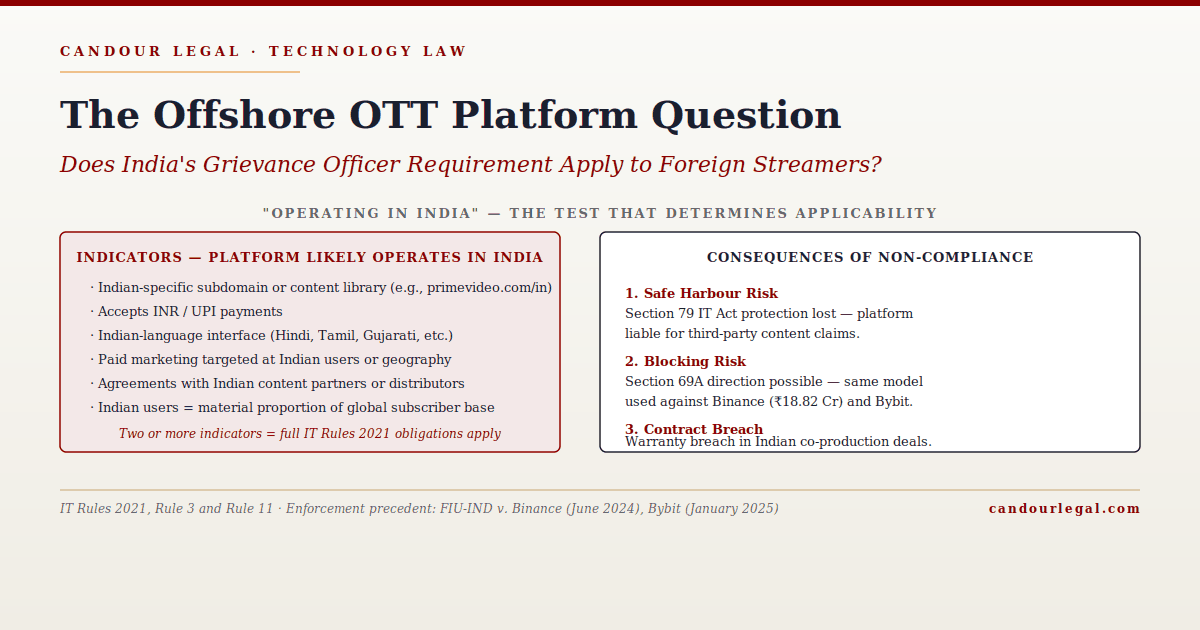
Every OTT platform that operates in India — whether incorporated in India or not — must appoint a Grievance Redressal Officer based in India under Rule 3 of the Information Technology (Intermediary Guidelines and Digital Media Ethics Code) Rules, 2021 (IT Rules 2021). The IT Rules do not limit this obligation to India-incorporated platforms, nor do they create a carve-out for platforms whose Indian user base falls below a particular threshold. The operative test is whether the platform operates in India — and the dominant interpretation of that test, consistent with how analogous Indian digital regulations have been enforced against offshore entities, is that it means offering services to Indian users in the course of business. On that interpretation, a foreign streaming service that accepts INR payments, maintains an Indian-language interface, or markets subscriptions to Indian consumers carries the same resident grievance officer obligation as a platform headquartered in Mumbai.
Key Takeaways
- Rule 3 and Rule 11 of the IT Rules 2021 require every publisher of online curated content operating in India to appoint a Grievance Redressal Officer based in India. The requirement is not limited to India-incorporated entities.
- The IT Rules 2021 do not define “operating in India.” The dominant interpretation, consistent with analogous enforcement, is that it means providing services to Indian users regardless of incorporation.
- An offshore platform accepting INR payments, maintaining an Indian-language interface, marketing to Indian consumers, or geographically targeting Indian users almost certainly “operates in India” for IT Rules purposes.
- The Resident Grievance Officer must be physically resident in India. Designating a compliance officer in the US, UK, or Singapore does not satisfy the requirement.
- Offshore SSMIs with more than five million registered Indian users additionally require a Chief Compliance Officer and Nodal Contact Person, both resident in India, and must publish monthly compliance reports.
- Non-compliance places the offshore platform’s safe harbour protection under Section 79 of the IT Act at risk and exposes it to blocking under Section 69A.
- The enforcement posture in FIU-IND action against Binance (₹18.82 crore, June 2024) and Bybit (₹9.27 crore, January 2025), and in CERT-In directions applied to offshore operators, supports an expansive extraterritorial reading of the IT Rules.
The Statutory Trigger
Rule 3(1)(c) of the IT Rules 2021 requires every intermediary to publish a grievance mechanism and appoint a Grievance Officer. Rule 11(1) — Part III, applicable to publishers of online curated content — requires the publisher to appoint a Grievance Redressal Officer based in India, who must take a decision on every grievance within the prescribed period (now 7 days under the IT Amendment Rules 2026, reduced from 15 days). Neither Rule 3 nor Rule 11 limits the obligation to India-incorporated entities. Section 1(2) of the Information Technology Act, 2000 extends the Act’s application to offences or contraventions committed outside India — and the extraterritorial intent of the parent statute informs the scope of the Rules made under it.
The “Operating in India” Test in Practice
The enforcement posture of Indian digital regulators in analogous contexts resolves much of the definitional uncertainty around what “operating in India” means. The Financial Intelligence Unit — India (FIU-IND) applied PMLA reporting-entity obligations to offshore Virtual Digital Asset Service Providers on the basis that they offered services to Indian users — irrespective of incorporation. Binance, incorporated offshore, was penalised ₹18.82 crore in June 2024; Bybit, similarly offshore, was penalised ₹9.27 crore in January 2025. CERT-In’s April 2022 directions apply to any person who collects, processes, and stores data in India — interpreted to include offshore cloud and data centre operators serving Indian users. The extraterritorial logic across these enforcement actions is consistent: serving Indian users in the course of a commercial activity is operating in India.
Two or more indicators → platform almost certainly operates in India and carries full IT Rules 2021 obligations.
The Residency Requirement for the Grievance Officer
The IT Rules 2021 specify that the Grievance Redressal Officer required under Part III must be “based in India,” and for SSMIs the Resident Grievance Officer must be a “resident in India.” A compliance officer in the platform’s San Jose or London headquarters given the title “India Grievance Officer” does not satisfy the requirement. The practical obligations of the role — acknowledging complaints within 24 hours, resolving within 7 days, appearing before the Grievance Appellate Committee through an Indian government portal — require a person operating in the Indian time zone, with access to Indian legal counsel, and with operational authority to take decisions on Indian content complaints. These requirements are incompatible with a nominal designation from outside India.
The most workable compliance structure for offshore platforms is appointing either a senior Indian-office employee (where an Indian legal entity or representative office exists) or an external compliance officer through an outsourcing arrangement with an Indian service provider. The officer’s name and contact details must be published on the platform’s Indian-facing interface and updated within two working days of any change. For a detailed breakdown of GAC proceedings — which the resident officer must be equipped to handle — see The Grievance Appellate Committee for OTT Content: Platform Obligations and Exposure.
Consequences of Non-Compliance
An offshore OTT platform serving Indian users without a resident grievance officer faces three categories of exposure. The first is safe harbour risk: Section 79 of the IT Act protects intermediaries from content liability conditional on due diligence. Failure to appoint a resident officer is a due diligence failure — and the platform cannot claim Section 79 protection against content-related claims by Indian users or rights holders. The second is blocking risk: Section 69A of the IT Act empowers the Central Government — acting through MIB or MeitY — to issue directions for the blocking of access to information. MIB has used this power against offshore platforms that failed to comply with content takedown directions; a pattern of IT Rules non-compliance, including failure to appoint a resident grievance officer, is a factual basis on which blocking proceedings could be initiated. The third is contractual exposure: co-production or content licensing agreements with Indian counterparties typically warrant IT Rules compliance as a condition of the agreement — non-compliance is a breach of that warranty and potentially a trigger for termination rights or indemnity claims.
What Offshore Platforms Must Do
The compliance path is straightforward in its steps, even if operationally non-trivial. First, identify whether the platform “operates in India” by applying the indicators above. If yes: designate a Resident Grievance Officer physically resident in India, with a published name, email address, and phone number on the Indian-facing interface; establish a grievance mechanism that issues unique reference numbers, acknowledges within 24 hours, and resolves within 7 days (or the faster timelines for the categories covered by the IT Amendment Rules 2026); maintain complete grievance records in a GAC-retrievable format; and if Indian registered users exceed five million, additionally appoint a Chief Compliance Officer and Nodal Contact Person resident in India and publish monthly compliance reports.
For platforms without an Indian subsidiary, the Resident Grievance Officer appointment can be structured through an external compliance services arrangement with an Indian provider, governed by a formal services agreement that grants the officer genuine decision-making authority over Indian content complaints. This is the most common structure used by mid-sized offshore platforms that have not yet established an Indian subsidiary. The arrangement should be reviewed annually to confirm the officer retains the authority and operational access necessary to discharge the role.
Looking Ahead
The IT Rules’ offshore application will be tested most visibly when an offshore platform receives a GAC ruling for failure to address a grievance. The GAC process is entirely online, requires no physical appearance, and is accessible to any Indian user — including users of foreign platforms. A GAC proceeding against an offshore platform that lacks a resident grievance officer would generate a documented government finding of non-compliance, and the enforcing authority would have clear grounds to escalate under Section 69A or through the MIB oversight mechanism. The Draft IT (Digital Code) Rules, 2026, which MeitY is reportedly preparing, may introduce explicit extraterritorial language clarifying that IT Rules obligations apply to any platform serving Indian users regardless of incorporation — analogous to the territorial scope provision in the Digital Personal Data Protection Act, 2023. Until that clarification is notified, offshore platforms should operate on the basis that the existing Rules apply to them, because the enforcement posture of Indian digital regulators indicates that is precisely how they will be applied.
Frequently Asked Questions
Does an OTT platform headquartered outside India need to appoint a grievance officer in India?
Yes, if it operates in India — meaning offering streaming content to Indian subscribers in the course of a commercial activity. The IT Rules 2021 are not limited to India-incorporated entities. An offshore platform with Indian subscribers, an Indian-language interface, or INR-denominated payments almost certainly carries the resident grievance officer obligation.
Can the grievance officer for an offshore platform be based outside India?
No. The IT Rules 2021 require the Grievance Redressal Officer under Part III to be “based in India.” Designating a compliance officer at the platform’s home country headquarters does not satisfy this requirement.
What threshold of Indian users triggers SSMI obligations for an offshore platform?
More than five million registered users in India, regardless of incorporation. An offshore streaming platform crossing this threshold must appoint a Chief Compliance Officer, Nodal Contact Person, and Resident Grievance Officer — all resident in India — and publish monthly compliance reports.
What is the risk of not appointing a resident grievance officer in India?
Loss of safe harbour protection under Section 79 of the IT Act for content-related claims; exposure to blocking proceedings under Section 69A; and breach of IT Rules compliance warranties in content licensing or co-production agreements with Indian counterparties.
Can an offshore OTT platform appoint an external compliance services provider as its Resident Grievance Officer?
Yes. An outsourced arrangement with an Indian service provider is a recognised structure. The arrangement must grant the officer genuine decision-making authority over Indian content complaints, and the officer’s details must be published on the Indian-facing interface.
Will the forthcoming Digital Code Rules resolve the offshore platform question?
Possibly. MeitY’s Draft IT (Digital Code) Rules, 2026 may introduce explicit extraterritorial language analogous to the DPDP Act 2023. Until then, offshore platforms should assume the existing Rules apply to them.
Speak to Candour Legal’s Technology Regulatory Team
Candour Legal advises offshore OTT platforms and foreign streaming services on India market entry compliance — IT Rules 2021 obligations, resident grievance officer structuring, SSMI threshold analysis, and DPDP Act readiness. The firm’s Ahmedabad office handles matters for companies entering the Indian market from the Gulf, UK, US, and Southeast Asia.
Schedule a 30-minute strategy callAbout the author
Hiren Thakkar, Advocate at Candour Legal, advises on intellectual property, technology regulatory compliance, and digital media law. Schedule a call with Hiren.
Candour Legal is a full-service Indian law firm with offices in Ahmedabad, Mumbai, and New Delhi. More on our Technology practice.
Further reading

Speak to a senior advocate about your matter.
Tell us what's going on. We review every enquiry personally and reply within 24 working hours.
Schedule a Consultation
Takes under a minute. We'll come back to you within 24 working hours.
Request received.
Thank you — a Candour Legal advocate will contact you within 24 working hours.
Urgent? Call us right away.
Disclaimer — Bar Council of India
As per the rules of the Bar Council of India, advocates and law firms are not permitted to solicit work or advertise. This website is intended solely to provide general information about Candour Legal and its areas of practice, and is made available to the user only at the user's own specific request. The contents of this website do not constitute, and should not be construed as, legal advice, an advertisement, a solicitation or an invitation of any kind. Candour Legal assumes no liability for any action taken in reliance on the material on this website; readers facing a legal issue should seek appropriate professional advice on their specific circumstances. Use of this website, or transmission of any enquiry through it, does not create a lawyer-client relationship between the user and Candour Legal.
BEFORE YOU GO
Get a free 15-minute case assessment
Tell us what's going on and a Candour Legal advocate will call you back — no charge, no obligation.
Schedule my free assessment Call now