Candour Legal – Best Lawyers in Ahmedabad | Law firm in Ahmedabad





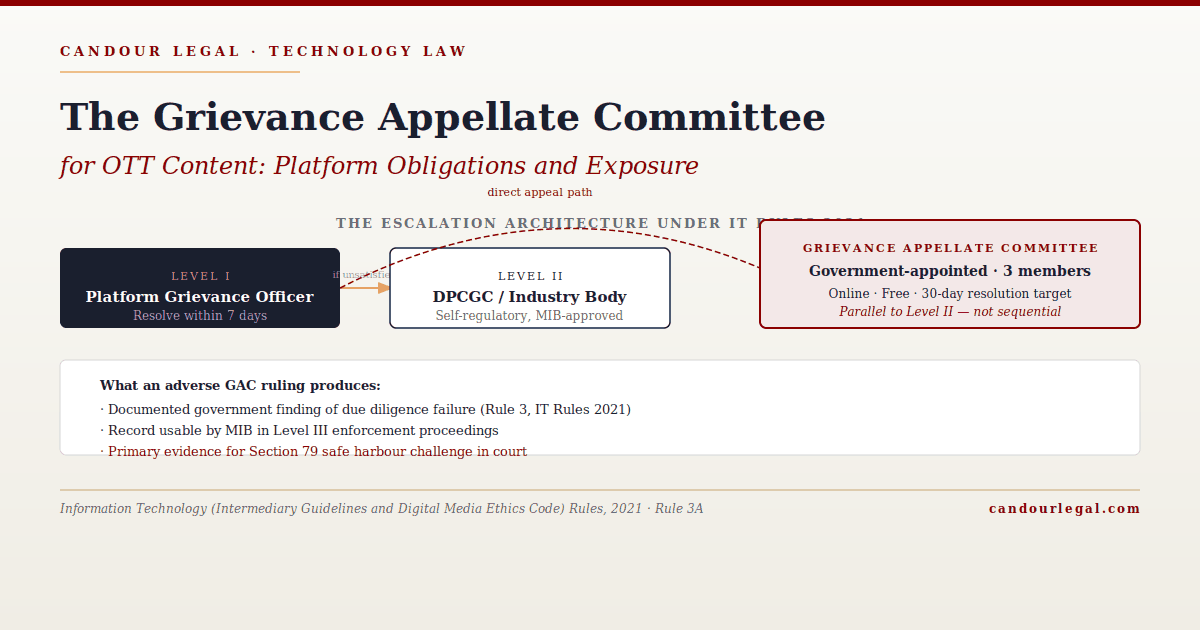
The Grievance Appellate Committee (GAC), introduced by the Information Technology (Intermediary Guidelines and Digital Media Ethics Code) Amendment Rules, 2022 and now embedded within the IT Rules 2021 framework, is the least-discussed element of India’s OTT compliance architecture. Most platform compliance briefs treat it as a backstop — the government mechanism that users can theoretically access if the platform fails them. That framing understates the GAC’s operational significance. A GAC finding against a platform is a documented government determination of compliance failure, creates a record usable in subsequent litigation or Ministry of Information and Broadcasting (MIB) enforcement proceedings, and will generate volumes that existing compliance teams are not resourced to manage once user awareness crosses the inflection point that consumer grievance mechanisms typically reach after a high-profile adverse ruling.
Key Takeaways
- The GAC consists of a chairperson and two whole-time members appointed by the Central Government, introduced by IT Amendment Rules, 2022 under Rule 3A of the IT Rules 2021.
- A user may appeal to the GAC within 30 days of: (a) receiving the Grievance Officer’s decision, or (b) expiry of the prescribed resolution period without a decision.
- The GAC must endeavour to resolve the appeal within 30 calendar days of receipt. The entire process is online and free to file.
- An adverse GAC ruling does not impose a financial penalty but constitutes a documented government finding of due diligence failure, usable in litigation and MIB enforcement proceedings.
- The GAC and the Level II industry body (DPCGC) are parallel mechanisms, not sequential — a user may appeal to the GAC directly after the Level I stage without going through Level II.
- Platforms must maintain complete grievance records — complaint, acknowledgement timestamp, investigation record, decision with reasons — for a minimum of two years.
- GAC filing volumes are currently low but will rise sharply once a high-profile adverse ruling reaches media attention.
What the GAC Is and How It Sits Within the Three-Tier Structure
Under the IT Rules 2021, the three-tier structure for OTT content regulation operates as follows. Level I is the platform’s own Grievance Officer, who must resolve complaints within 7 days under the IT Amendment Rules 2026 (reduced from 15 days). Level II is a self-regulatory body formed by publishers — the Digital Publisher Content Grievances Council (DPCGC), formed by the Internet and Mobile Association of India (IAMAI), is the operative body for OTT platforms. Level III is MIB’s Inter-Departmental Committee and oversight mechanism.
The GAC sits outside this three-tier publisher-specific structure. It is a parallel government mechanism for users — not a Level IV in the publishing chain, but an appellate body directly over Level I. A user dissatisfied with the Grievance Officer’s decision, or whose complaint was not addressed within the prescribed period, may appeal directly to the GAC without first exhausting the Level II industry body. This parallel architecture means a complaint escalated to the DPCGC at Level II may simultaneously be the subject of a GAC appeal — platforms need compliance protocols that track both channels simultaneously, not sequentially. For the broader context of OTT grievance officer obligations post the 2026 amendment, see OTT Grievance Officer Obligations in India: The 2026 Compliance Reset.
The GAC Process
The GAC portal is maintained by MeitY and operates entirely online. Filing is free. A user submits the appeal through the portal, identifies the platform and the Grievance Officer’s decision (or its absence), and provides the complaint reference number issued at Level I. The GAC notifies the relevant platform, which is expected to file its complete grievance record in response: the original complaint, the acknowledgement timestamp, the investigation record, and the decision with reasons.
The “endeavour to resolve within 30 calendar days” formulation is significant. It is not a hard deadline — the GAC may take longer where the matter is complex. But the 30-day target reflects the intent that GAC proceedings should be faster than ordinary litigation. For a platform, this means a complaint that failed at the Level I stage can result in a GAC decision within 30 days of the user filing an appeal — and within days of receiving the GAC notice, the platform must have its complete grievance record available for submission. Document retention is therefore not a procedural nicety — it is the platform’s only practical defence in a GAC proceeding.
What a GAC Ruling Means in Practice
The IT Rules 2021 do not prescribe a financial penalty for an adverse GAC ruling. The GAC is not a penalty-imposing authority in the manner of a court or tribunal. What an adverse GAC ruling produces is threefold: first, a documented government finding that the platform failed its due diligence obligations under Rule 3 of the IT Rules 2021; second, a record that MIB can cite in its Level III oversight mechanism if it chooses to issue a warning, an advisory, or initiate further proceedings; and third, primary evidence for a litigant challenging the platform’s safe harbour claim under Section 79 of the Information Technology Act, 2000.
The safe harbour implication is the most consequential. Section 79 of the IT Act protects intermediaries from liability for third-party content, conditional on the intermediary observing due diligence. A GAC finding that the platform failed to address a grievance within the prescribed timeline is prima facie evidence that due diligence was not observed — and a litigant who obtains that finding has a materially stronger Section 79 challenge than they would without it.
The Readiness Gap at Most Platforms
A GAC appeal requires the platform to produce, typically within days of receiving the GAC notice: the complete complaint file; the acknowledgement record with timestamp; the investigation record showing what steps the Grievance Officer took; the decision with reasons; and any correspondence with the user. Most platforms have some of this documentation. Few have a protocol that systematically creates and retains all of it in a format retrievable within 48 hours of a GAC notice.
The gaps observed in practice: platforms that acknowledge complaints via automated systems but do not retain the acknowledgement record in a case-linked format; platforms whose Grievance Officer decisions are communicated by email but not logged against the original complaint reference; platforms that close complaints as “resolved” without documenting the reasons; and platforms with no identified internal escalation point for a GAC proceeding. The IT Amendment Rules 2026’s compression of timelines — general grievance from 15 days to 7 days, serious content from 24 hours to 2 hours — makes these documentation gaps more acute, because there is almost no margin for documentation alongside resolution at the tighter deadlines.
What Platforms Must Do
Platform compliance teams should audit their grievance record infrastructure against a single test: can the platform, within 48 hours of receiving a GAC notice, produce the complete grievance file in a format suitable for submission to the GAC portal? If the answer is no, the infrastructure gap must be closed before GAC filing volumes increase.
The practical steps are: assign a named GAC response coordinator distinct from the Grievance Officer who is the subject of the appeal; implement complaint-file structures that automatically associate all correspondence and action records with the original complaint reference number; retain all grievance records for a minimum of two years; and prepare a template GAC response that can be populated with the specific complaint record within 24 hours of notice. For SSMIs, monthly compliance reports should include a GAC-specific section tracking pending appeals, decisions received, and adverse findings — this creates the management visibility needed to detect content-category patterns before they become enforcement patterns.
Looking Ahead
The GAC will become a more prominent institution as user awareness rises. Free filing, an entirely online process, and a 30-day resolution target make it more accessible than consumer forums or civil courts for users with content grievances — including users of foreign platforms, since the GAC process requires no physical presence in India. Once the first high-profile GAC ruling against a major OTT platform receives media attention — probable within the next 12 to 18 months — filing volumes will rise sharply and the readiness gaps at most platforms will be exposed simultaneously. Platforms that build GAC-ready compliance infrastructure now will be in a materially stronger position than those that treat the GAC as a theoretical risk until that inflection point arrives.
Frequently Asked Questions
What is the Grievance Appellate Committee and who can approach it?
The GAC is a three-member government body — a chairperson and two whole-time members appointed by the Central Government — that hears appeals from users dissatisfied with OTT grievance officer decisions. Any user in India who has filed a complaint with a platform’s Grievance Officer and is dissatisfied with the outcome, or whose complaint was not resolved within the prescribed period, may file an appeal with the GAC.
What is the timeline for GAC proceedings?
A user must file the appeal within 30 days of the Grievance Officer’s decision or the expiry of the resolution period. The GAC must endeavour to resolve the appeal within 30 calendar days of receipt. The entire process is online and free to file.
Can the GAC impose a financial penalty on an OTT platform?
No. An adverse GAC ruling is a documented government determination of due diligence failure, usable in litigation and MIB enforcement proceedings and to challenge the platform’s safe harbour status under Section 79 of the IT Act. It is not a penalty order.
Must a user exhaust the Level II self-regulatory body before filing with the GAC?
No. The GAC and the Level II body (DPCGC) are parallel mechanisms. A user may appeal to the GAC directly after the Level I Grievance Officer stage without going through the Level II body first.
How long must an OTT platform retain grievance records?
The IT Rules 2021 do not prescribe a specific retention period. As a practical matter, platforms should retain complete grievance files — complaint, acknowledgement, investigation record, decision with reasons — for a minimum of two years to cover GAC filing windows and subsequent litigation exposure.
Does the GAC handle both OTT content complaints and social media complaints?
Yes. The GAC’s jurisdiction covers appeals against grievance officer decisions by any intermediary covered by the IT Rules 2021, including OTT platforms, social media intermediaries, and digital news publishers.
Speak to Candour Legal’s Technology Regulatory Team
Candour Legal advises OTT platforms and digital media publishers on grievance mechanism design, GAC response protocols, document-retention frameworks, and IT Rules 2021 compliance. The firm represents clients before MIB, MeitY, and in High Court proceedings on digital media regulatory matters.
Schedule a 30-minute strategy callAbout the author
Hiren Thakkar, Advocate at Candour Legal, advises on intellectual property, technology regulatory compliance, and digital media law. Schedule a call with Hiren.
Candour Legal is a full-service Indian law firm with offices in Ahmedabad, Mumbai, and New Delhi. More on our Technology practice.
Further reading

Speak to a senior advocate about your matter.
Tell us what's going on. We review every enquiry personally and reply within 24 working hours.
Schedule a Consultation
Takes under a minute. We'll come back to you within 24 working hours.
Request received.
Thank you — a Candour Legal advocate will contact you within 24 working hours.
Urgent? Call us right away.
Disclaimer — Bar Council of India
As per the rules of the Bar Council of India, advocates and law firms are not permitted to solicit work or advertise. This website is intended solely to provide general information about Candour Legal and its areas of practice, and is made available to the user only at the user's own specific request. The contents of this website do not constitute, and should not be construed as, legal advice, an advertisement, a solicitation or an invitation of any kind. Candour Legal assumes no liability for any action taken in reliance on the material on this website; readers facing a legal issue should seek appropriate professional advice on their specific circumstances. Use of this website, or transmission of any enquiry through it, does not create a lawyer-client relationship between the user and Candour Legal.
BEFORE YOU GO
Get a free 15-minute case assessment
Tell us what's going on and a Candour Legal advocate will call you back — no charge, no obligation.
Schedule my free assessment Call now