


By Candour Legal Team · Legal position reviewed on 14 November 2026
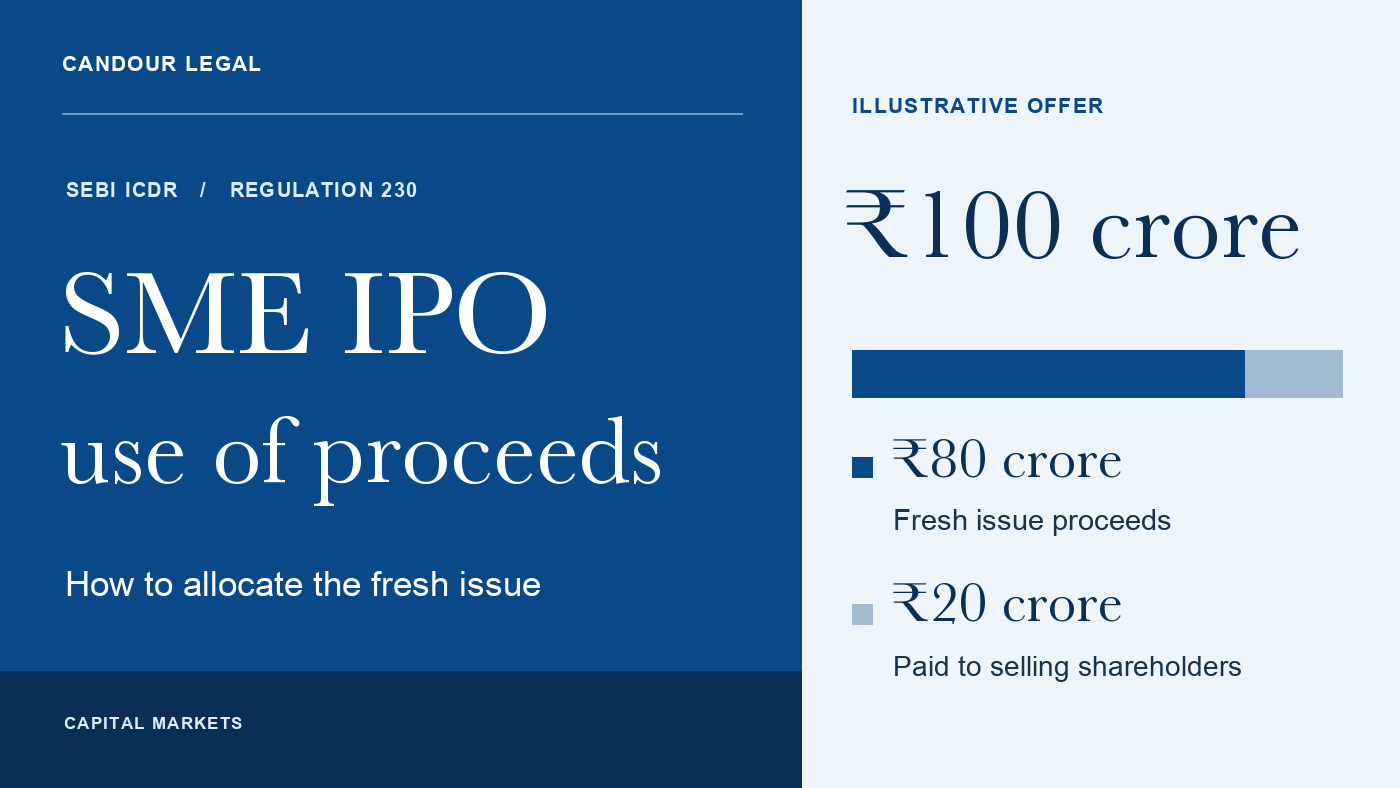
An Indian company proposes an ₹80 crore SME IPO fresh issue. It budgets ₹10 crore for general corporate purposes and ₹20 crore for acquisitions it has yet to identify. Each amount fits its individual ceiling. Together they exceed SEBI’s ₹28 crore combined limit by ₹2 crore. Before a board approves the objects of the issue, it should test the allocations together and trace any proposed debt repayment to its ultimate recipient. ICDR regulation 230(1)(h), (2) and (3).
Check the ₹80 crore worked budget
Start with the money the issuer will receive
The SEBI (Issue of Capital and Disclosure Requirements) Regulations, 2018 calculate the spending caps on the amount raised by the issuer. An SME IPO may also include an offer for sale (OFS), where the money goes to selling shareholders. Keep that sum outside the issuer’s budget. Show the fresh proceeds, the expenses chargeable to the company and the net amount available for deployment in a reconciliation that the board can follow. ICDR regulation 230(2)–(3).
Three spending limits apply at the same time
- General corporate purposes. Use the lower of 15% of the fresh amount and ₹10 crore. An identified purpose with no specific allocation can fall here, as can an amount described as general corporate purposes under another name. An unallocated issue expense does not enter this category merely because its amount has yet to be specified. ICDR regulation 2(1)(r) · ICDR regulation 230(2).
- Unidentified acquisition or investment targets. The issuer may allocate up to 25% of its fresh raise to these objects. An identified acquisition or strategic investment falls within the proviso to regulation 230(3) only if suitable specific disclosures appear in both the draft offer document and the offer document at filing. A reference to a preferred sector or an acquisition pipeline does not identify a transaction. ICDR regulation 230(3) and its provisos.
- The combined amount. Add general corporate purposes to the amount for unidentified targets. The sum must stay within 35% of the fresh raise. Commitments under one heading reduce the room under the other. ICDR regulation 230(3).
Worked budget for a ₹100 crore offer
Assume an industrial company offers ₹80 crore of fresh shares alongside a ₹20 crore OFS. It funds issue expenses separately. Its board wants to retain the maximum permissible general corporate allocation, leave some room for acquisitions and spend the balance on specified plant and equipment.
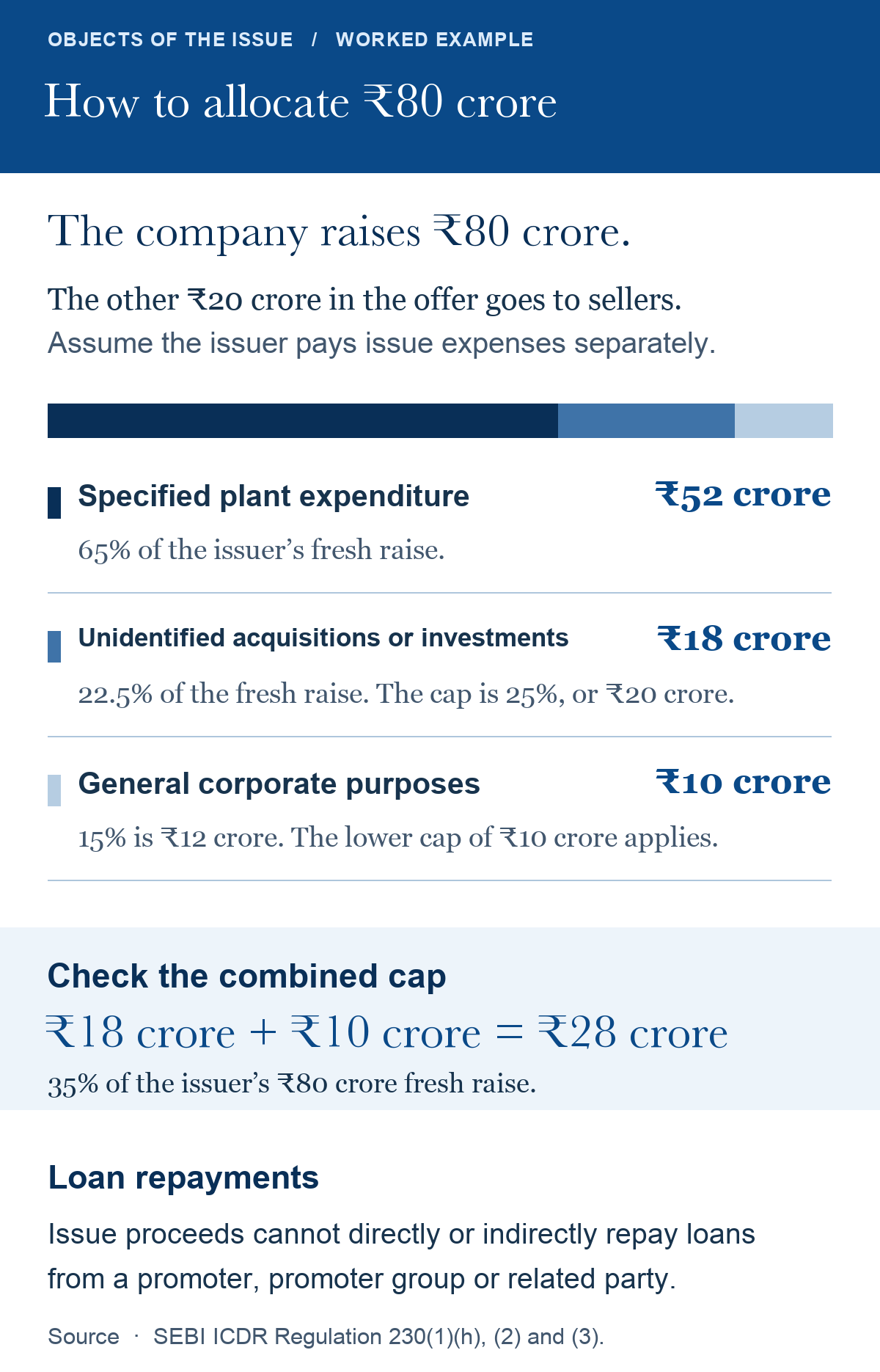
Fifteen per cent of ₹80 crore is ₹12 crore, so the absolute cap brings general corporate purposes down to ₹10 crore. The unidentified-target ceiling is ₹20 crore, but the two headings together cannot exceed ₹28 crore. The board can therefore budget ₹18 crore for unidentified targets and ₹52 crore for specified equipment. If it wants ₹20 crore for unidentified targets, it must reduce general corporate purposes to ₹8 crore or less.
Check how much of an SME IPO can be an offer for sale
Follow a loan repayment to the final payee
Regulation 230(1)(h) prohibits an issue object that would repay a loan taken from a promoter, promoter group or any related party, directly or indirectly, out of issue proceeds. Its scope turns on the source of the loan and how the money moves. A borrower cannot use its general corporate allocation to bypass the restriction. ICDR regulation 230(1)(h) · NSE Emerge listing conditions.
For example, suppose a promoter lends the company ₹3 crore to buy machinery. The purchase invoice proves a capital expenditure, but reimbursing the promoter with IPO cash would repay the prohibited loan. For a proposed bank refinancing, obtain the original sanction, drawdown records, payment instructions and lender ledger. Establish what the bank financed, whether a promoter loan was bridged and who ultimately receives the issue money. A genuine third-party borrowing requires its own review of the applicable conditions and disclosures.
Prepare the monitoring file before the prospectus
For a fresh issue above ₹50 crore, regulation 262(1) normally requires monitoring by a SEBI-registered credit rating agency. The provision excepts issues by banks, public financial institutions and insurers. For the industrial issuer in the example, arrange monitoring and map each object to invoices, account entries and its deployment schedule. The agency reports quarterly until full utilisation. The issuer publishes the report and files it with the exchange within 45 days of each quarter-end. ICDR regulation 262(1)–(4).
Where a monitoring agency is not required, the statutory auditor certifies fresh-proceeds utilisation to the SME exchange with quarterly results until full use. Separately, a working-capital object above ₹5 crore triggers an auditor’s certificate with quarterly results, using the format disclosed in the offer document, until the working-capital proceeds are fully used. ICDR regulation 262(5)–(6).
SEBI’s October 2026 consultation proposes removing the absolute ₹10 crore general corporate purposes ceiling while retaining the 15% limit. The current budget must still satisfy both. SEBI consultation, §5.2 · Candour Legal’s analysis of the SME IPO consultation.
Frequently asked questions
Can the company calculate the limits on an IPO that includes an offer for sale?
Use only the amount the issuer raises through fresh shares. In a ₹100 crore offer with ₹20 crore payable to selling shareholders, the denominator for the spending limits is ₹80 crore.
On a ₹40 crore fresh issue, can the issuer allocate ₹10 crore to general corporate purposes?
No. Fifteen per cent of ₹40 crore is ₹6 crore, which is below the absolute ₹10 crore ceiling. At ₹6 crore of general corporate purposes, the combined limit leaves up to ₹8 crore for unidentified acquisition or investment targets.
Does naming a target remove the general corporate purposes cap?
No. Regulation 230(3) makes a limited exception for an identified acquisition or strategic investment supported by suitable specific disclosures in the draft and final offer documents. The separate general corporate purposes ceiling and related-party loan repayment restriction still apply.
Does a ₹5 crore working-capital allocation trigger a separate auditor certificate?
Regulation 262(6) applies where the working-capital object exceeds ₹5 crore. Exactly ₹5 crore does not cross this threshold. Other monitoring or certification duties can still apply to the issue.


Speak to a senior advocate about your matter.
Tell us what's going on. We review every enquiry personally and reply within 24 working hours.
Schedule a Consultation
Takes under a minute. We'll come back to you within 24 working hours.
Request received.
Thank you — a Candour Legal advocate will contact you within 24 working hours.
Urgent? Call us right away.
Disclaimer — Bar Council of India
As per the rules of the Bar Council of India, advocates and law firms are not permitted to solicit work or advertise. This website is intended solely to provide general information about Candour Legal and its areas of practice, and is made available to the user only at the user's own specific request. The contents of this website do not constitute, and should not be construed as, legal advice, an advertisement, a solicitation or an invitation of any kind. Candour Legal assumes no liability for any action taken in reliance on the material on this website; readers facing a legal issue should seek appropriate professional advice on their specific circumstances. Use of this website, or transmission of any enquiry through it, does not create a lawyer-client relationship between the user and Candour Legal.
BEFORE YOU GO
Get a free 15-minute case assessment
Tell us what's going on and a Candour Legal advocate will call you back — no charge, no obligation.
Schedule my free assessment Call now