


By Candour Legal Team · Legal position reviewed on 15 November 2026
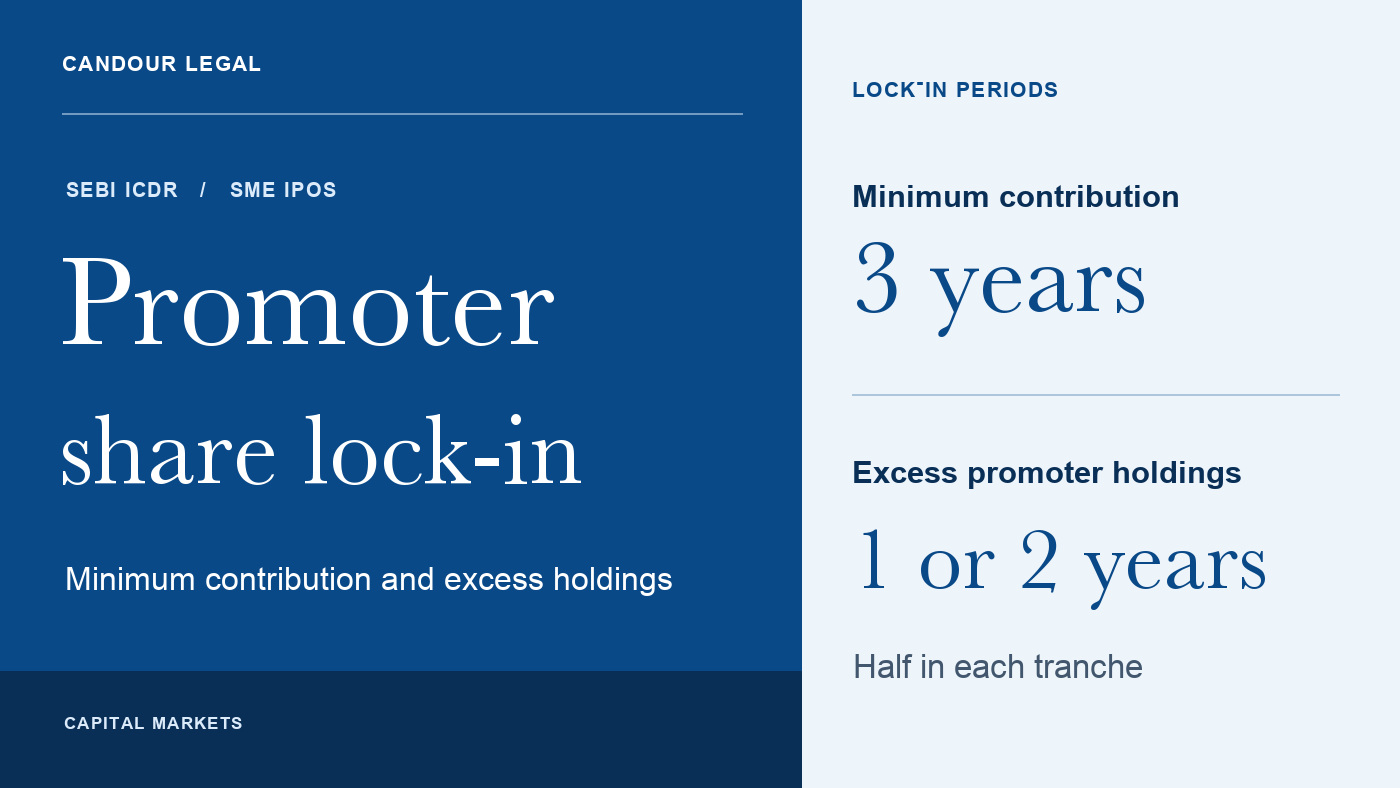
A promoter who retains half of a company after its SME IPO may hold shares with three different lock-in anniversaries. Under the current SEBI ICDR Regulations, an ordinary equity IPO generally requires eligible minimum promoters’ contribution of at least 20% of expanded post-issue capital. The minimum carries a three-year lock-in. Of the promoters’ remaining holding, half carries a two-year lock-in and half a one-year lock-in. Which shares count, and when the three-year clock starts, matter as much as the percentage. ICDR regulation 236 · ICDR regulation 238.
See the worked promoter lock-in schedule
Work out the minimum after dilution
Start with the post-issue capital table. Include the equity expected from full proposed conversion of convertible securities and the exercise of all vested options where employee stock options or stock appreciation rights are outstanding. Identify the promoters’ retained holdings after any proposed sale. Existing eligible shares can meet the minimum. The IPO timetable must provide for the contribution requirement to be met at least one day before issue opening. ICDR regulation 236(2) and its explanation.
Where promoters would hold less than 20%, specified contributors may cover a shortfall of up to 10% of the post-issue capital without themselves being identified as promoters. The list includes alternative investment funds, foreign venture capital investors, scheduled commercial banks, public financial institutions, IRDAI-registered insurers, a non-individual public shareholder with at least 5% of post-issue capital, and a promoter-group member other than a promoter. Verify the contributor against the actual statutory category. An issuer with no identifiable promoter is exempt from the minimum requirement. ICDR regulation 236(1) and its provisos.
Screen the shares before assigning them to the minimum
A holding on the cap table is only the starting point. Under regulation 237, shares pledged to any creditor cannot count towards the minimum. Check securities acquired in the preceding three years for non-cash consideration involving asset revaluation or capitalisation of intangibles. Also flag bonus issues backed by revaluation reserves or unrealised profits, and bonus shares arising from ineligible shares. A former partnership or LLP must also check the special rules for contributions against recent funds brought into the predecessor firm. The regulation contains exceptions, including for certain approved schemes. ICDR regulation 237(1)(a) · ICDR regulation 237(1)(d) and (2).
Check the acquisition price of shares obtained in the preceding year against the IPO price, adjusting for corporate actions such as a split or bonus issue. A lower-priced acquisition can be ineligible, subject to exceptions. One expressly permits the applicable contributor to pay the issuer the price difference. Keep allotment records, acquisition consideration and proof of any payment with the working. ICDR regulation 237(1)(b) and its provisos.
Assign the minimum and the excess to separate clocks
For the minimum contribution, calculate three years from the later of IPO allotment and commencement of commercial production. For this purpose the latter is the last day of the month in which the offer document expects commercial production of the project funded by the issue to commence. That detail matters to an existing manufacturer raising money for a new plant. The date its existing business began trading does not establish the relevant date for the new project. ICDR regulation 238(a) · ICDR explanation to regulation 238.
Split the excess promoter holding equally. One half is locked for two years from IPO allotment and the remainder for one year from allotment. For an older IPO, check the draft filing date: the March 2025 notification applies the staggered excess rule to draft offer documents filed after 8 March 2025. Amending notification, clause 2. Ordinary non-promoter pre-issue capital generally carries a one-year lock from IPO allotment under regulation 239. For example, eligible pre-issue shares held outside the minimum contribution by a venture capital fund, a Category I or II alternative investment fund, or a foreign venture capital investor carry a minimum one-year period from purchase. Identify the holder’s capacity before assigning dates. ICDR regulation 238(a)–(b) · ICDR regulation 239.
Worked example: 50 lakh promoter shares, three anniversaries
Assume 100 lakh ordinary shares on an expanded post-issue basis and 50 lakh eligible, unpledged shares retained by the promoters. The promoters provide the entire minimum. Assume draft filing in 2026 and IPO allotment on 16 November 2026. The offer document expects commercial production at the issue-funded plant in April 2027.
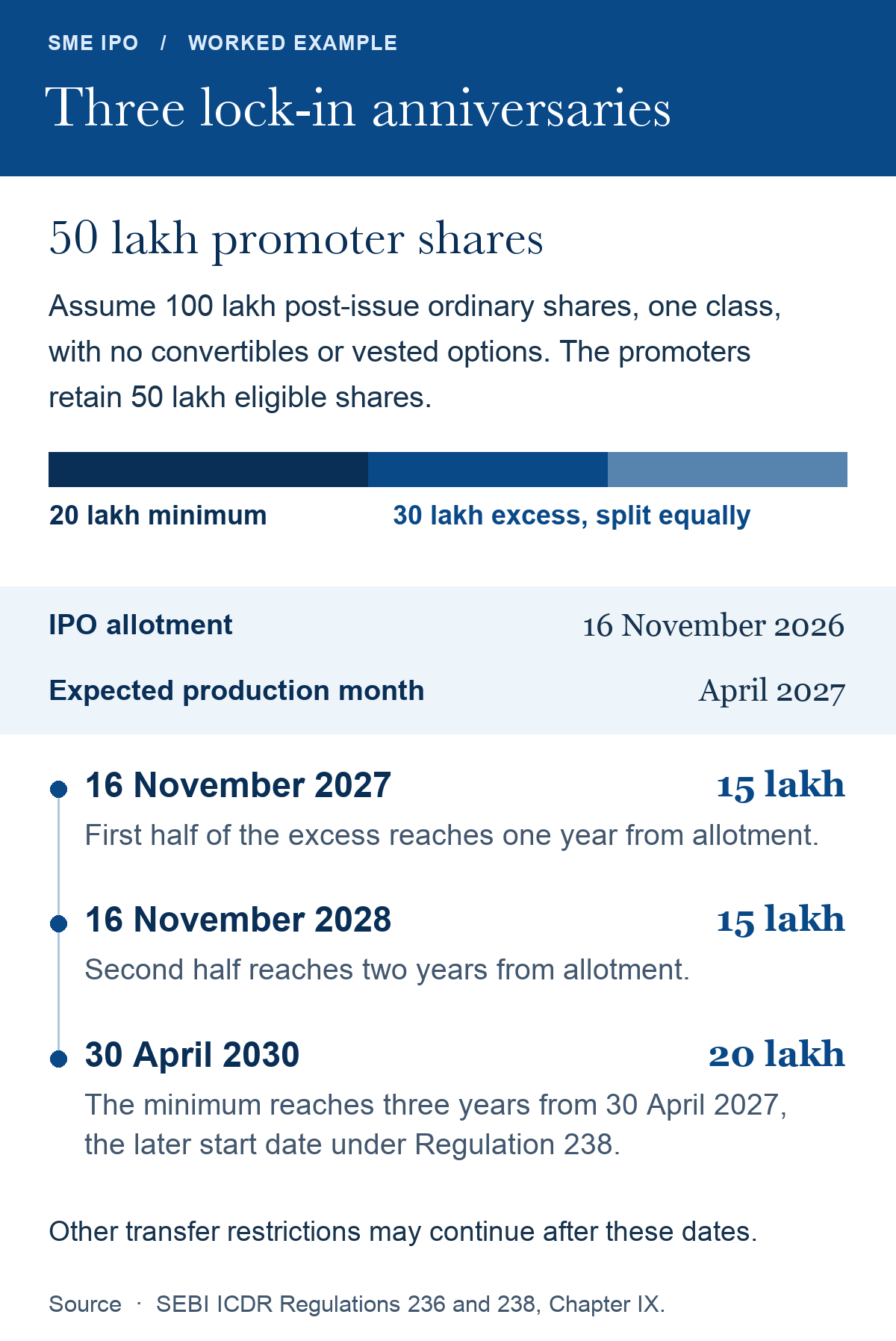
The minimum is 20 lakh shares. The later date for this block is 30 April 2027, so its three-year anniversary is 30 April 2030. The other 30 lakh shares split into 15 lakh reaching one year on 16 November 2027 and 15 lakh reaching two years on 16 November 2028. A proposed sale still requires verification of the depository position and any other applicable restrictions.
Check the separate limits on shares sold in the IPO
What to settle before the draft offer document
- Agree the denominator. Reconcile the share register to depository balances and model conversions, vested instruments, fresh allotments and shares the promoters propose to sell.
- Identify eligible lots. Record the holder, acquisition date, price, source of funds, corporate actions and encumbrances. If a new subscription is needed, check the escrow and offer-document cash-flow requirements. ICDR regulation 236(2)(d)–(e).
- Document the start dates. Match the project’s expected production month to the objects and implementation schedule. At allotment, reconcile the final minimum and both excess blocks to the lock-in instructions.
SEBI’s October 2026 consultation proposes starting the three-year minimum period at allotment and giving the entire excess promoter holding a one-year period. As of 15 November 2026 these remain proposals. SEBI consultation, §5.4 · Candour Legal’s consultation analysis.
Frequently asked questions
Must promoters put in fresh cash equal to 20% of the IPO size?
For an ordinary SME equity IPO, the starting test is an eligible contribution equal to at least 20% of expanded post-issue capital. Eligible existing shares can satisfy it. The issuer should establish any shortfall before arranging a new subscription.
Can shares pledged to a bank count towards the minimum?
Regulation 237(1)(d) excludes securities pledged with any creditor. If the issuer proposes to rely on a release of the pledge, obtain evidence of the completed release and then recheck all other eligibility conditions for those shares.
If six promoters hold shares, must each own 20%?
The ordinary rule applies to the collective promoter contribution. Reconcile the eligible quantity provided by each contributor to the total minimum, then map each retained share to the applicable lock-in.
Does a three-year anniversary always fall three years after listing?
For the minimum contribution, use the later of IPO allotment and the statutory commercial-production date for the issue-funded project. The excess promoter shares use IPO allotment as their starting date. Keep the listing date separate.


Speak to a senior advocate about your matter.
Tell us what's going on. We review every enquiry personally and reply within 24 working hours.
Schedule a Consultation
Takes under a minute. We'll come back to you within 24 working hours.
Request received.
Thank you — a Candour Legal advocate will contact you within 24 working hours.
Urgent? Call us right away.
Disclaimer — Bar Council of India
As per the rules of the Bar Council of India, advocates and law firms are not permitted to solicit work or advertise. This website is intended solely to provide general information about Candour Legal and its areas of practice, and is made available to the user only at the user's own specific request. The contents of this website do not constitute, and should not be construed as, legal advice, an advertisement, a solicitation or an invitation of any kind. Candour Legal assumes no liability for any action taken in reliance on the material on this website; readers facing a legal issue should seek appropriate professional advice on their specific circumstances. Use of this website, or transmission of any enquiry through it, does not create a lawyer-client relationship between the user and Candour Legal.
BEFORE YOU GO
Get a free 15-minute case assessment
Tell us what's going on and a Candour Legal advocate will call you back — no charge, no obligation.
Schedule my free assessment Call now