Candour Legal – Best Lawyers in Ahmedabad | Law firm in Ahmedabad





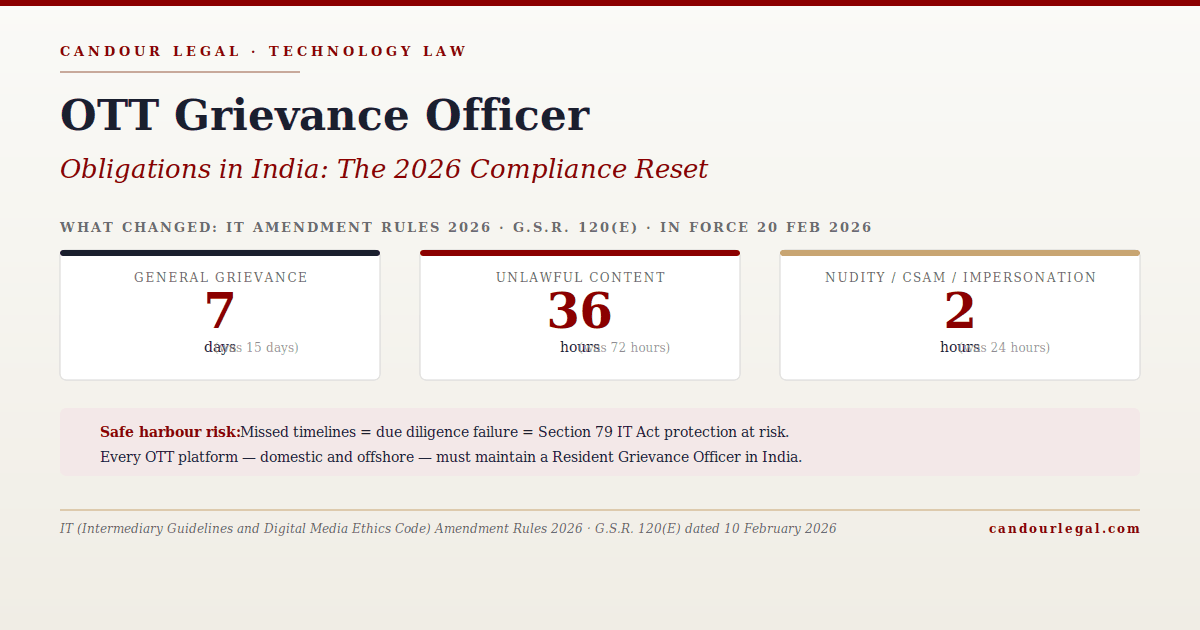
The Information Technology (Intermediary Guidelines and Digital Media Ethics Code) Amendment Rules, 2026 — notified by the Ministry of Electronics and Information Technology (MeitY) vide Gazette Notification G.S.R. 120(E) dated 10 February 2026 and in force from 20 February 2026 — have reset the grievance timelines that apply to intermediaries under Rule 3(2). The amendment is not incremental. For intermediaries, it halves the general grievance resolution window, compresses the unlawful-content takedown timeline, and introduces a two-hour hard deadline for the most serious categories of harmful content. An OTT platform, as a publisher of online curated content under Part III, still has its Grievance Officer acknowledge within 24 hours and decide within 15 days (Rules 10/11). For compliance teams at streaming platforms — domestic and offshore alike — the operative question is not whether their existing standard operating procedures require revision, but how quickly that revision can be operationalised.
Key Takeaways
- The IT Amendment Rules 2026 (G.S.R. 120(E), 10 February 2026, in force 20 February 2026) reduce the grievance resolution period for intermediaries from 15 days to 7 days for general complaints; OTT streaming services, as publishers of online curated content under Part III, must still have their Grievance Officer acknowledge within 24 hours and decide within 15 days under Rule 10.
- For intermediaries, the unlawful-content removal timeline has been reduced from 72 hours to 36 hours; the timeline for nudity, CSAM, and impersonation content has been reduced from 24 hours to 2 hours.
- Every OTT platform operating in India — including offshore platforms serving Indian users — is a publisher of online curated content governed by Part III of the IT Rules 2021 (Code of Ethics, three-tier mechanism), and its Grievance Officer must acknowledge complaints within 24 hours and decide them within 15 days under Rule 10, with escalation to the Level II self-regulating body if not decided within 15 days.
- Section 79 safe harbour under the Information Technology Act, 2000 protects intermediaries for third-party information; it is relevant to an OTT platform only to the extent it also hosts user-generated content.
- Significant Social Media Intermediaries (SSMIs) — platforms with more than five million registered users in India — face additional obligations: Chief Compliance Officer, Nodal Contact Person, Resident Grievance Officer, monthly compliance reports, and proactive technical verification of synthetically generated information (SGI).
- The Grievance Appellate Committee (GAC) under Rule 3A — three government-appointed members — hears appeals only against decisions of an intermediary’s Grievance Officer, within 30 calendar days.
- MIB confirmed in December 2025 that OTT content falls outside the Central Board of Film Certification’s jurisdiction — IT Rules 2021 govern OTT content, not the Cinematograph Act, 1952.
The Statutory Architecture
The IT Rules 2021, notified on 25 February 2021 under Section 87 of the Information Technology Act, 2000, established for the first time a structured compliance framework for publishers of online curated content — the category under which OTT streaming platforms fall. Part III of those Rules imposed a three-tier oversight structure: Level I self-regulation by the platform, Level II oversight by an industry self-regulatory body, and Level III government oversight by the Ministry of Information and Broadcasting (MIB) through an Inter-Departmental Committee. At the platform level, the publisher is required to appoint a Grievance Redressal Officer based in India, publish that officer’s name and contact details prominently on its website and application, acknowledge complaints within 24 hours, and resolve them within 15 days.
For intermediaries, the original 15-day framework, which many platforms struggled to meet even in its unrevised form, has been substantially tightened by the 2026 amendment to Rule 3(2). Subsequent amendments in 2022, 2023, and 2025 had left the core grievance timelines intact. For OTT publishers under Part III, the Grievance Officer still acknowledges within 24 hours and decides within 15 days (Rules 10/11).
The 2026 Amendment: What Changed and What Did Not
The IT Amendment Rules 2026 operate on two fronts simultaneously — grievance timeline compression and synthetically generated information (SGI) regulation. The grievance changes amend the intermediary timelines in Rule 3(2). The acknowledgement obligation — 24 hours from receipt — has not changed. What has changed is every downstream resolution deadline for intermediaries; an OTT publisher’s Grievance Officer still decides within 15 days (Rules 10/11).
| Category of Complaint | Pre-2026 Timeline | Post-2026 Timeline |
|---|---|---|
| General user grievance | 15 days | 7 days |
| Unlawful content — Rule 3(1)(b) | 72 hours | 36 hours |
| Nudity, CSAM, impersonation | 24 hours | 2 hours |
| Acknowledgement of receipt | 24 hours | 24 hours (unchanged) |
The safe harbour implication is direct. Section 79 of the IT Act protects intermediaries from liability for third-party content provided the intermediary observes due diligence in its functioning. Rule 3 of the IT Rules 2021 defines that due diligence. Failure to resolve grievances within the prescribed timelines is a due diligence failure — and a due diligence failure is precisely what the Section 79 safe harbour is conditioned on. A platform that accumulates unresolved or delayed grievances is building a record that could be used by a litigant or the government to challenge its safe harbour claim. The two-hour window for the most serious categories — content depicting nudity, child sexual abuse material, impersonation — is operationally near-impossible to meet without automated detection and round-the-clock staffing.
The Grievance Appellate Committee: The Escalation Path
The Grievance Appellate Committee (GAC) — comprising a chairperson and two whole-time members appointed by the Central Government — was introduced under the 2022 amendments to the IT Rules. A user whose grievance against an intermediary is either not resolved within the prescribed period by the Grievance Officer, or who is dissatisfied with the Officer’s decision, may appeal to the GAC within 30 days of receiving the Officer’s communication. The GAC must endeavour to resolve the appeal within 30 calendar days of receipt, through an entirely online process.
The GAC creates a formal escalation path above the platform — a material shift from the original self-regulatory model. A GAC ruling against a platform is not merely a compliance finding; it creates a documented record of platform failure that can be cited in subsequent litigation or MIB enforcement proceedings. An OTT platform needs a GAC response protocol only to the extent it also hosts user-generated content as an intermediary (for its own curated content, escalation from the Level II body is to Level III, the MIB oversight mechanism, under Rules 9–14): a named internal escalation point, a document retention practice for all grievance-related correspondence, and a legal response template for GAC proceedings. For a detailed analysis of the GAC mechanism, see The Grievance Appellate Committee for OTT Content: Platform Obligations and Exposure.
What OTT Platforms Must Reset Now
For large domestic platforms — Netflix India, Amazon Prime Video India, Disney+ Hotstar, SonyLIV, Zee5 — to the extent they also host user-generated content as intermediaries, the 2026 amendment requires a systematic audit of existing grievance infrastructure against the new timelines, not a checkbox review but a genuine assessment of whether staffing, tooling, and escalation protocols can meet a 7-day general window and a 2-hour window for serious content categories. Platform compliance teams must: audit current average grievance resolution time against the new 7-day ceiling; deploy or upgrade automated detection for content falling in the 2-hour category; establish 24×7 coverage for the 36-hour and 2-hour categories (which are incompatible with a Monday-to-Friday staffing model); update the public-facing grievance policy to reflect the new timelines; and establish a GAC response protocol and document-retention practice.
Regional and smaller OTT platforms — Gujarati, Marathi, Bhojpuri, and Tamil regional streaming services — face the same obligations with a fraction of the compliance budget. The 2026 amendment does not calibrate intermediary timelines by platform size or user base. A regional platform with 800,000 subscribers in Gujarat that hosts user-generated content carries the same two-hour obligation for the most serious content categories as Netflix. For these platforms, the practical route is a shared compliance arrangement through an industry body, supplemented by a clear internal escalation chain and outside counsel on retainer for urgent matters.
The SGI Layer: What the 2026 Amendment Adds for SSMIs
For platforms qualifying as Significant Social Media Intermediaries — those with more than five million registered users in India — the 2026 amendment adds a synthetically generated information (SGI) compliance layer. SSMIs must obtain a declaration from users regarding whether uploaded content is SGI, deploy technical measures to verify the accuracy of those declarations, and ensure that SGI content is appropriately labelled. Failure to act against knowingly permitted unlawful SGI constitutes a due diligence failure, directly threatening safe harbour status under Section 79 of the IT Act.
The February 2026 amendment’s MeitY FAQ addresses several practical scenarios: a platform offering a tool to generate realistic AI videos or cloned voice notes is covered by the SGI provisions; clearly labelled satire and parody is not. The boundary between clearly labelled creative content and deceptive synthetic content will generate early disputes, and platforms should expect the first GAC proceedings in this area within the next 12 months. For offshore platforms serving Indian users, see The Offshore OTT Platform Question: Does India’s Grievance Officer Requirement Apply to Foreign Streaming Services?
Looking Ahead
Three developments warrant tracking over the next 18 months. The Draft IT (Digital Code) Rules, 2026, which MeitY is preparing and which draw from the 1994 Cable TV framework, may introduce further structural changes to OTT regulation — potentially including a registration or licensing requirement that currently does not exist. The Digital Personal Data Protection Act, 2023, with full compliance obligations from 13 May 2027, will impose a separate but overlapping layer on how platforms process the personal data of complainants using the grievance mechanism — a grievance log is a personal data repository, and the grievance resolution timelines must be reconciled with the DPDP’s data minimisation and storage-limitation principles. And the GAC, currently generating low filing volumes, will see a sharp increase as user awareness rises — particularly after the first high-profile adverse ruling against a major platform receives media coverage.
Frequently Asked Questions
What is the new grievance resolution timeline for OTT platforms under the 2026 amendment?
For intermediaries, the IT Amendment Rules 2026 (G.S.R. 120(E), in force 20 February 2026) reduce the general grievance resolution period from 15 days to 7 days; unlawful content removal from 72 hours to 36 hours; and content depicting nudity, CSAM, and impersonation from 24 hours to 2 hours. The 24-hour acknowledgement obligation is unchanged. OTT streaming services are publishers of online curated content under Part III: under Rule 10 the publisher’s Grievance Officer must still acknowledge within 24 hours and decide within 15 days, with escalation to the Level II self-regulating body if not decided within 15 days.
Does an OTT platform based outside India need a Resident Grievance Officer in India?
Yes, where the platform serves Indian users in the course of business. The dominant interpretation, consistent with analogous Indian digital regulation enforcement, is that operating in India means serving Indian users regardless of place of incorporation. An offshore streaming platform with Indian subscribers requires a resident officer in India.
What happens if a platform’s Grievance Officer fails to act within the prescribed timeline?
For an OTT publisher’s own curated content, the complaint escalates to the Level II self-regulating body and then to Level III (MIB oversight mechanism) under Rules 9–14. Where the platform acts as an intermediary, a user may appeal to the Grievance Appellate Committee (Rule 3A) within 30 days; the GAC must endeavour to resolve the appeal within 30 calendar days, and a pattern of missed timelines constitutes a due diligence failure under Rule 3, threatening safe harbour protection under Section 79 of the IT Act.
Are OTT platforms covered by the CBFC’s certification requirements?
No. The Minister of State for Information and Broadcasting confirmed in the Lok Sabha on 17 December 2025 that OTT platforms fall outside CBFC jurisdiction. OTT content is governed by the IT Rules 2021, not the Cinematograph Act, 1952.
What additional obligations apply to SSMIs?
SSMIs must appoint a Chief Compliance Officer, Nodal Contact Person, and Resident Grievance Officer — all resident in India — and publish monthly compliance reports. The 2026 amendment adds SGI-specific obligations: user declarations, technical verification, and content labelling.
Does the DPDP Act affect how OTT platforms manage the grievance mechanism?
Yes, indirectly. Grievance logs contain personal data of complainants. The Digital Personal Data Protection Act, 2023 and DPDP Rules 2025 will impose data minimisation and storage-limitation obligations on that data from 13 May 2027. Platforms should audit their grievance data practices now against the DPDP framework.
What is the Grievance Appellate Committee and how does it differ from the Level II self-regulatory body?
The GAC is a government-appointed body hearing user appeals online within 30 days. The Level II body (DPCGC) is an industry-constituted self-regulatory mechanism. They are not parallel tracks: the GAC (Rule 3A) hears appeals only against decisions of an intermediary’s Grievance Officer, while for an OTT publisher’s content, escalation from the Level II body is to Level III (MIB oversight mechanism) under Rules 9–14.
Speak to Candour Legal’s Technology Regulatory Team
Candour Legal advises OTT platforms, streaming services, digital media publishers, and social media intermediaries on IT Rules 2021 compliance, grievance mechanism design, GAC proceedings, and DPDP Act obligations. The firm represents clients before MIB, MeitY, and in High Court proceedings on digital media regulatory matters.
Schedule a 30-minute strategy callAbout the author
Hiren Thakkar, Advocate at Candour Legal, advises on intellectual property, technology regulatory compliance, and digital media law. Schedule a call with Hiren.
Candour Legal is a full-service Indian law firm with offices in Ahmedabad, Mumbai, and New Delhi. The firm advises on technology regulatory compliance, IT Act matters, digital media law, and intellectual property. More on our Technology practice.
Further reading

Speak to a senior advocate about your matter.
Tell us what's going on. We review every enquiry personally and reply within 24 working hours.
Schedule a Consultation
Takes under a minute. We'll come back to you within 24 working hours.
Request received.
Thank you — a Candour Legal advocate will contact you within 24 working hours.
Urgent? Call us right away.
Disclaimer — Bar Council of India
As per the rules of the Bar Council of India, advocates and law firms are not permitted to solicit work or advertise. This website is intended solely to provide general information about Candour Legal and its areas of practice, and is made available to the user only at the user's own specific request. The contents of this website do not constitute, and should not be construed as, legal advice, an advertisement, a solicitation or an invitation of any kind. Candour Legal assumes no liability for any action taken in reliance on the material on this website; readers facing a legal issue should seek appropriate professional advice on their specific circumstances. Use of this website, or transmission of any enquiry through it, does not create a lawyer-client relationship between the user and Candour Legal.
BEFORE YOU GO
Get a free 15-minute case assessment
Tell us what's going on and a Candour Legal advocate will call you back — no charge, no obligation.
Schedule my free assessment Call now